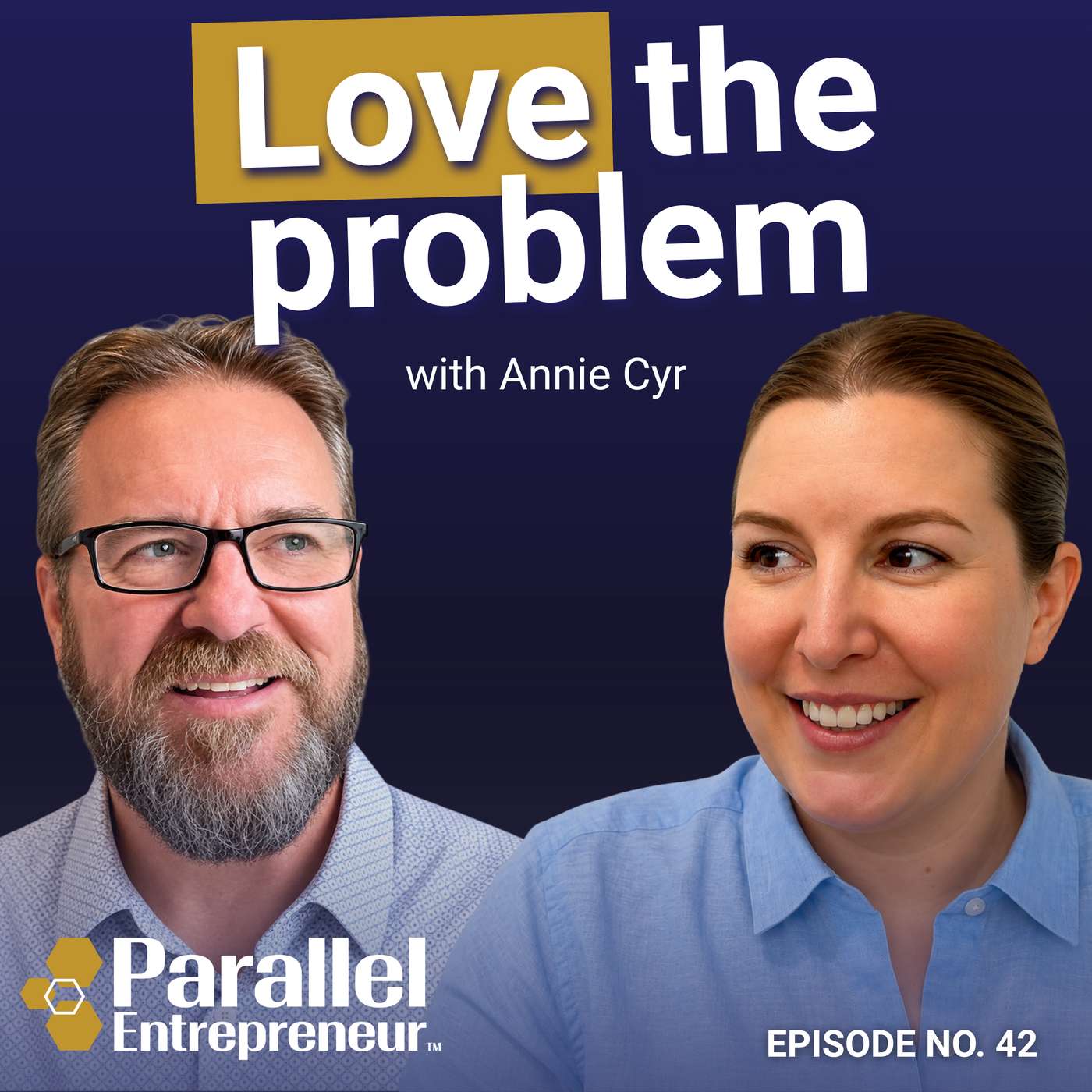
Episode 42 · Annie Cyr

Fall in Love With the Problem, Not the Solution | Annie Cyr

Parallel Entrepreneur with Mark Cleveland · Episode 42

0:00 / 45:21
Fall in Love With the Problem, Not the Solution | Annie Cyr
0:00 / 45:21

Episode notes

Annie Cyr saw a gap in the textile industry, wrote the book she couldn't find, and years later built the technology she wished existed.

In this episode of The Parallel Entrepreneur, Annie joins Mark Cleveland to share the journey from writing The Guide to Textile Fibers to co-founding Tengiva, and what she's learned trying to modernize a complex global industry from the inside.

The conversation goes well beyond textiles. Annie shares why founders should "fall in love with the problem, not the solution," how she decides which opportunities are worth pursuing, why she tested existing technology before building her own, and what fundraising has taught her about choosing the right partners.

They also get into something every entrepreneur eventually has to confront: knowing your own limits. Annie shares an unexpected lesson from her time working in a hospital emergency department and how it shaped the way she approaches leadership, balance and building a company today.

For anyone turning deep industry experience into a business, there's plenty here to apply.

In this episode
• Why Annie spent three years writing a textile reference book
• How industry experience led to the creation of Tengiva
• Why founders should fall in love with the problem, not the solution
• How to innovate without trying to replace everything that already works
• Why textile industry knowledge is so difficult to digitize
• How Tengiva prioritizes which customer problems to solve
• Why transparency and proprietary knowledge don't have to be opposites
• Annie's approach to selling without "selling"
• Why she tested existing technology before building her own
• When customers should fund your growth — and when outside capital makes sense
• What Annie has learned from raising venture capital
• Why industry experience matters when hiring
• The difference between competing with others and becoming better than yourself
• What working in a hospital emergency department taught Annie about balance
• Her vision for making textile sourcing more accessible to the next generation of creators

About Annie Cyr
Annie Cyr is the CEO and co-founder of Tengiva, a technology company modernizing commercial operations across the global textile industry.

Before building Tengiva, Annie spent years working across textile development, sourcing and procurement. She is also the author of The Guide to Textile Fibers: Clothing and Fashion Industry, a practical reference created after a university professor challenged her to write the resource she couldn't find herself.

Together with co-founder Carlos Agudelo, Annie began the Tengiva journey in 2018, testing existing technologies before ultimately deciding the industry needed technology purpose-built around the way textile businesses actually operate.

Follow Annie on LinkedIn

Links & Resources
Tengiva
Happy Overall
The Parallel Entrepreneur Podcast

About the Host
Mark Cleveland is an entrepreneur, investor, and advisor who works at the intersection of multiple ventures. As the voice behind The Parallel Entrepreneur, he explores how founders build aligned businesses, strong teams, and sustainable momentum without forcing themselves into a single path.

Follow Mark on LinkedIn

Subscribe for more conversations with founders, investors, operators, and creators building extraordinary lives across multiple ventures.

Related conversations
Stop Planning. Start Building. — Daniel Innovaté on treating AI as a collaborator rather than a replacement for human expertise
Michael Built a Cybersecurity Empire — Then Let Competitors Use His Tools — Michael Peters on why openness and proprietary advantage don't have to be opposites
Strategic Alignment of Talent, Tech & Data — Amy Henderson on turning hard-won industry knowledge into systems and teams
Growth Doesn't Work the Old Way Anymore — Caitlin MacGregor, a fellow founder, on hiring for potential and building enterprise SaaS

Chapters

Full transcript

Fall in love with the problem and [music] not with the solution. If you fall in love with the solution, you will never adapt to the problem. Learn with other people's [music] money. Don't reinvent the wheel before trying what exists in the market. Never try to be better than the other. Become better than yourself. [music] Today's guest is Annie Cyr, CEO and co-founder of Tengiva, the leading platform modernizing one of the world's largest and [music] most complex industries, textiles. She wrote the authoritative textbook in the space.

She went inside the industry, deep inside, and watched how one of the largest, most complex industries on the planet was still running on spreadsheets, gut instinct, and tribal knowledge. What she saw, she couldn't unsee. That became Tengiva, a venture-backed platform quietly rewiring how manufacturers, suppliers, and brands in this textile world actually connect and do business, not by disrupting from the outside, but by understanding the industry well enough to rebuild it from within. Annie, welcome to the parallel entrepreneur. Take us back to the moment that uh you challenged the system and then the professor challenged you and why what was behind you writing? What was the experience of writing the

defining reference resource for the textile industry? It was actually out of a need. I had this class on textile. Incredible uh knowledge was being shared by the professor and as I was reading and going through the material I was wondering like okay I want to learn more what's next and you either had these massive bibles or these small books saying oh wool is nice. I was like, "Okay, there's kind of no middle ground. Just dominate down into a single uh page where I can see, oh, this fiber performs best for those." So, I turned to my professor who to me had all of the legitimacy to be writing such a book and I said, "Why don't you write a book? There's like this massive gap in the market." And she

said, "I don't have time. Why don't you Why don't you write?" launched me on this three-year journey aside of studying, working in the industry and everything to actually go through all the knowledge, more than 80 books, capturing all of these data, these performance and synthesizing it into a 100 something page book that contains a comparator where you can say, okay, I want to create, let's say, a fabric that will um dry fast or that will resist to UV and then from there you have like these graphs and you can find what would be the best blend to achieve your results.

So this is a three-year odyssey. What did it teach you about how information and knowledge is stored in or or not stored in the textile industry? So you know in textiles you're familiar with it. They will use the word technology to talk about new fibers and new weave. Exactly. But for us, you and I, technologies is often the software related to it. What I've learned through that is like the technical behind the fabric. How does it works? How will it react? What I did not learn from that because I was in book was the industry experience. This is an untold truth, untold reality, untold elements that are not written anywhere. What is MOQ, MOQ, uh, lead time, lab dip, and so on. How

does that work? The only way I could learn that aspect was by working in the industry, with the suppliers, with the brands, and with the whole ecosystem. There's no book on that. I was always shocked in the textile business how many handoffs there are between supplier for raw material and and the movements and the shipments and the storage and the and then the processing and the weaving and the and the binding and the coloring and and walk us through from your perspective.

Um it's a com I I called it a complex industry earlier. I think that's from my experience. Would you agree and how would you describe it? In which way? There are so many ways it can be complex. Yeah. [laughter] Uh if we look for example on a standpoint of just the commercial aspect ordering textiles because of we have like we are consumer as well and we're so used to go online and find everything we want and get it delivered. kind as human like got used to this facility.

When you start in the textile industry as an external person who's not familiar with the industry, you're faced with actually a completely different approach in terms of how people sell, how they buy, how you pay, and so on. For example, you've been through that you need to make a first prototype or you're happy overall. What do you do? So now with Tengiva software, you could go online and do find suppliers that are powered by our software and yes, find stock levels and see what they have. That's how we're changing the game. But the reality of the industry outside of Tengiva's reality

is you need to go to a trade show. You need to meet the suppliers. You need to see what they have in stock. You still can do that with Tengiva. You'll have the iPad. It continues. Don't worry, it doesn't change that. But it will accelerate certain discovery stage as well. And then you want what? 5 10 meter to do your first prototype, right?

What happens when you ask that? Tell me. You've been there. Oh, well they say our minimum order is,000 yards or 10,000 yards. Uh but we can send you a swatch. The minimums, the volume, the global nature of the industry, uh very complex. What's the difference between disruption and innovation in your approach to this business? I think innovating has to respect the established culture. This is you don't want to change how people interact or connect. You just want to make it easier and more fluid.

That's how we see it. We don't want to change like trade shows is fun. You know, you go there, you discover, you like it's like candy land for someone who like textiles. It's like you go there like this is all the new stuff. Yeah. It's everything that is new. It's fun and you touch and Yes. out. [laughter] Exactly. And and it's like a curated topic like a lot of these trade show was specialized on sports, on denim, on couture, on X. So you go there and you have in one place like a curated selection of textile producers that can serve what you need and what you're looking for. And like we said in the beginning, you will never remove the human the tangible aspect of the

textile. I don't believe this will be removed ever. But what is fun when you're there and what is fun when you're with your sales rep is that they tell you about the new things. You want them to be a consultant. You want them to be a coach to you. I'm doing my new happy overall. This is what I need. What is the best thing you would recommend and why would you recommend it? That's what you want them to do with you. You don't want to start doing administrative and taking notes and you want that to just happen in the back.

You want to be continue being with the person. It's your expert, your coach. And AI will not replace it. It's going to enhance it. Yeah. It's going to help your research. It's going to give these things. But there are certain things when you're with the rep that they can tell you, "Oh, but have that thing that is new and actually come and see it.

Let's play with it." And it creates this dynamic that is so essential. So that's how we see innovation. It's about let's remove what's inefficient, the administrative, the the part we don't want to focus on so that we focus our energy on what is value added. One of our um client conducted a a research internally or an analysis internally on how much time it sales team was spending on non- sales-related uh activities and this is not an isolated case just so you know that's one example but it's the same situation in 90% of the textile

businesses You know how much? 80% of their time on sales related. Ouch. Ouch. Tracking stuffing down. Tracking stuff down in operations or in production. If you're a salesperson, you want to be with the people. You want to do business. You're proactive. It's their mindset. So that's what we do. We give them tools to be better at what they do and to focus on more what they do best.

In the parallel entrepreneur lived experience, one of our greatest challenges is identifying opportunities and you're living in a world that's just just full of them and uh prioritizing the solution and their time. How do you what's your secret sauce for prioritizing opportunities in this market? What is most critical for our clients in their commercial operation and the biggest gain they can have? So this is really where we start and do the focus currency. Most of textile companies uh work in USDs. USD, everyone is quite familiar with the currency. But in some other markets where we're really growing like Brazil, 90% of their trade is

actually inside the country. So they are not trading in US and they are not familiar just yet to be pricing their product in USD. So that was a critical point that our clients in Brazil which represent quite a substantial amount of our client base needed in priority. So that's how we do in terms of what is most priority pri took over priority to uh to focus on. you just described a unique market with a unique problem with a unique uh relationship with its marketplace versus India where we've sourced some handloom fabric. Uh then I

think we have to pay in their currency so we have to do a conversion. Uh there are other obviously China, Vietnam, the rest of the of the world where uh textiles are produced. That's still a huge number of different feedback loops and and customer priority like everybody's saying solve my problem first. How do you weight these decisions?

First it's to evaluate uh the proportion of demand. So for example, the currency, we have a an important client base that was asking for this functionality and that it was key for them to be able to fully use our software. Is it feasible and worth it for the rest of the client? So is it something that will take three months and impact other developments and should we balance it out? So it's really a case by case. We don't develop everything that clients ask, not in the get-go. And because uh maybe an important point about our software, how it's built, is that it's one-size-fits-all. Everybody is on the same

version. So they don't need to do updates. They don't need to like change. It's always the latest version. And there's no I want an extra functionality. Everyone has it all. It's unlimited seats. It's everyone has access to all the functionality. We really make it accessible so they get the full benefits of it. So when we take a decision to release something, we say will it benefit all of our client and are we developing it with all our clients in the mindset? But it came originally from a key uh urgency from one group.

Okay. Well, so this is interesting because I think in your uh presentations and writings that u have influenced the industry, I think you recognize that you you do things your way and not the way of the competition. I think that's a direct quote and and you're trying at the same time to operate and in a genuinely conservative even a I think this is a fair term, even a protectionist industry. Um, and if there's a longestablished protectionist culture around proprietary knowledge, this seems to me at least at the root of why things don't get systemized and computerized and automated and you're trying to solve for accessibility in information. Um, is

is there is this proprietary knowledge about how something is built or made or the inks used and and the different uh is there a tension with your emphasis on differentiation and building toward a shared anonymized industry sort of knowledge base and community? One of the main fear that you've likely encounter is I don't want my products to be copied.

What they discover in the way we address that element is it's more detrimental for them to hide it than to show it. What I mean by that is for example price. Price is a key variables that is very very important for textile supply. So how we build up the price into our software is a bit different. So how it works is that client only sees the price that is applicable to them. It's always depending on the volume they want to purchase. You know the price is not the same if you want to buy 5 m or if you're going in full production mode and you go

for a,000 meter. So we've developed the software in a way that when the client goes into meeting certain for example the minimums then they see the price for the minimums directly. So they feel more like a sense of protection because the filtering is done automatically by recognizing who's connected and who has access to depending on the volume they want to purchase or not. and the buyer on its side, it's also more transparent because you're like, "This is what they would tell me anyway if I call them." So, it's kind of the middle ground. We found ways that supplier would feel protected and buyers would feel transparency through it, but it's always

a middle ground into how to navigate through these fears, through these knowledge and this It's change management in the end. Yeah. Yeah. That's a great that's a great observation. Almost everything fundamentally comes down to your skills in change management. Right. I know this industry to be a male-dominated industry.

That's just that's my personal experience. Challenge me if if I don't have that right. What are your superpowers that have helped you get traction? I don't sell to people. First, I'm a passionate person. So when I speak with the clients or the users, I don't speak out of a sales piece pitch. I speak out of my own art. Like I've built it because I needed it. Like I was in the shoes of your client and I needed it.

And then it's about how to make them see in their current process, not criticize. I think we should never criticize. always say so this is good from what you have today but here's by adding this little thing how more you can do with it this is my superpower and creating mental image with the client I say okay you are physically in your trade show booth your client has taken 10 20 30 fabric swatch hangers and put it on your table. What's next? You know, it will take note, broach a bit your business card or sometimes they have an Excel or sometimes they have an ERP with barcodes.

It's wildly varies. Exactly. And then I explain them. So imagine instead you take your phone or your client can't even do it. You both have access. You scan, you save exclient during this trade show was looking for that and then like a Google doc you type in and then you share and your client has it about three weeks later before they leave your boot.

I got I got swatches after the January trade show that were four months later delivered from Korea and I like I completely disconnected from the original inquiry etc. But I you you it sounds like your superpower is about connection uh collaboration but not conversion. You're not trying to convert anybody. No. Exactly. Yeah. It's about them taking ownership about the software and what they see it could be beneficial to them. One of the main question I ask actually clients at the beginning of the meeting I say before I tell you anything about what it does is imagine you have a magic wand in your hand.

What would you have a tool do for you that would save you time as a commercial director? And the answer is always magic. Magic. [laughter] So what what lessons have you learned early in your career that still influence you today? The first one is always fall in love with the problem and not with the solution because this is the best way.

You were asking about focus earlier. If you fall in love with the solution, you will never adapt to the problem. Whereas if you target a problem, your solution will adapt to it. This is it sounds simple, but 90% of the people fall into it. And you have and even I at some point I fell into it. Everyone does. It's normal. And it's when you notice it, just ask yourself, is it the right solution for the problem I'm targeting?

And this will guide all of your decision. The other one is smell. Like when you arrive so rigid into a meeting, people are already in the defense mode. Anyone even if they know you, everyone is always in a defense mode. And when someone smiles, you cannot not smile. You cannot be cold. So it just lightens up the room. And just smile. You don't need to say anything. Just smile. It changes the whole mood, makes everyone feel more comfortable. It makes you feel more comfortable so you're more fluid into your conversation. The most important one is learn with other people's money. Don't reinvent the wheel before trying what exists in the market.

Like when we started, we spend the first two years even before we became a technology testing existing technology from the market. We had a vision. we were seeing something, we said, "Okay, let's try what already exists. Let's tear it down and break it and let's see if it could be applied and actually if that solution could solve this problem." What we've learned is that all these existing technology were not built for it. So that's where we said, okay, there's clearly a gap. Existing technology don't solve it. We need to build the technology.

So we learned from other people's mistake or errors or the way they've built it on how we could build our solution better. That's what I mean by learn with other people money not take investors money and spo spend it. It's not it. Okay. My grandfather made that more approachable for me as one of my life lessons. He said, "Mark, if you want to be successful, learn from the mistakes of others. They're the least expensive kind." You got it exactly.

My friend Brandon shared a piece of advice recently. Dress so that if someone dressed up as you for a costume party, everyone would know it was you. Now, that's not entirely about clothing. That's about identity, about showing up fully. My wife Jenny and I are leaning in on this concept both in our personal lives and now in a little startup we call Happy Overall. We're making overalls. Each one is made to order as a wearable canvas for art. Overalls that [snorts] are comfortable, durable, and expressive. We're sourcing soft 100% cotton. We're partnering with designers and with local seamstresses who love the artistry of a well-crafted piece of

clothing. So check out happyoverall.com to see pics and see if anything resonates with you. fully you and it'll happen every time you reach for them. If you want to be part of the first run, join our waitlist at happyoverall.com. Talk to me about the lessons uh that you've learned in fundraising because that's something that entrepreneurs are always concerned about capital and and not other people's money but money that wants to be attracted to your business and there's an opportunity to exploit an you know in in your case like this almost limitless set of opportunities.

Um you raised capital the traditional way, the hard way. Okay. What did you learn in your capital raising journey as a CEO? So another part of uh these feedbacks I give to entrepreneurs is to define their pathways. I don't see like it as technologies and innovation or like I see it as the way you you fund your business and the way you will grow. I think there's a traditional approach which means you grow as you sell as your natural growth goes. I call it the traditional aspect. So more you sell more you have money and more you grow and reinvest and so on. It works very

well for many business model. And then you have the other pathway that for example us the level of advancement of our technologies very complex. Uh we're talking like a single transaction financial transaction or payment can be subdivided and automatically paid across a 100 payments. So the level of financial complexity just on that aspect and reporting and tracking and and so on requires massive investment from the get-go. So you need to bring in more funds before you become profitable.

Whereas on the traditional aspect, you're becoming profitable and you're growing and you're scaling with your profitability. I think this is always the first question someone should ask and always try to see if there's a way they can go the traditional way. Not all software needs to go the complex fundraising aspect. Don't go there. If you can do it like by growing in a progressive way.

So if your customers can fund your growth, that's the way you should go. If you can do go. If you have a a plan that makes it, if it's the right product, if it's the right approach, go this direction. Fundraising, I got to admit, I kind of have fun doing that, but it's not for everyone. People hate it normally. I have fun. It's like a It's very challenging. You learn how to fit with your partners, with your investors, what they can bring to the table. What um what is the vision? Do you and your investors have the same long-term vision? Are you going in the same direction? And this will be key for the growth, for the future of the company.

It's not I decide everything. We work as a team because they come in as a partner in it. And you have to see it in this way. If you could go back and tell the student who wrote that textbook the truth about what this journey actually looks like, what would you say to yourself? Never try to be better than the other. Become better than yourself.

So too many people just focus on what the competitor does and they want to like go faster, go better than the competitor. It's okay to know what they do. It's okay to see where your competitor is, but be yourself. Have your own line because you're going to go faster because you're not going in the same direction likely than your competitor.

Set your goal. Go ahead. Know your competitors, but don't become better than them. set your own bars and go better than yourself and you will go much faster and much much further. This is what drove me every single day and what brought us I look at some of my competitors back in the days. They are world aparts. They failed many of them because they focus on trying to go in one their trajectory and I was going in that one and I knew that one was the good one. So it's good.

I know they're there but I'm going that way because that's what I know out of my expertise the right trajectory to to achieve it. What is it like for you to recruit talent into this industry into solving this problem that you're trying to solve? The most difficult skill set to teach to a new person that joins not technology but for example in customer success management.

The one thing I cannot teach is the textile industry experience. The person needs to come with it. They need to have seen it. They need to have lived the pain. And then it's just about sitting down, walking them through how this would have changed their life in their previous job. And then they get it and then it becomes part of their story of how they explain how they walk people. Oh my god, I remember that time like us today. I remember that time. It was so complicated. If I would have had that, it would have changed it that way. They make it their own.

Make it their own. I remember taking uh the entire Swiftwick team on factory tours. Like I I was supplying and and dealing with innovation and working with the engineers who had come up with unique properties in certain technology that was their textile, right? How they created it. It was absolutely fascinating. And then I decided, well, I'm going to bring the sales people and the customer service people and the operations people and the shipping people. Our entire company would go on field trips and we would go to the dying facility or to the weaving facility or to the place where they make um individual threads. Uh actually and one

of those experiences I remember I got to see how uh dental floss is made. You know, it's amazing how many different materials that we could talk about, but side-by-side processing, no plant, drive 3 hours to another plant, drive six hours to another plant. I mean, it was very distributed. It was a joycreating experience for me to watch my vendors tour their facilities and have our team jaw dropped at what what what level of industry and size of the machines and the scale of the power and and the buildings. Uh this industry is awesome.

And then at the same time, you know, with Happy Overall, we're working with cottage startup company kinds of um seamstresses and and people that are actually assembling the product because they love love love what they do. And it's micro industry. 10 years from now, you you hung it up and you were done. What What is the thing that you will have accomplished in this industry that you'll be known for?

I don't want to be known for. I don't need to be known for. I'm not doing Tengiva for that. I really do it out of I've had the pain of the brand's side. Mhm. navigating hundreds of material tracking information and so on and feeling like I was only leveraging 5% of everything every new innovation already in the market and I just know how it could help the industry have helped me in the past and this is what drives me every day. I just want to solve that pain I used to have for all the other people in the industry. That's really it.

It doesn't need to have my name. It's just about solving it so that we the whole industry continues. The textile industry built cities. It built a whole ecosystem in in countries and education and school and so on. and so core and we so forget it every day but it's everywhere around us and I do believe it deserves this place as a beautiful innovative industry that is seen as an example for all the other supply chain that's why we do it if you could wave a magic wand this is the question you ask your customers if you could wave a magic wand what would it be I want to be able to see everything every textile in the world

in one place to discover all the supplier and know who's the best and where to go and not miss one like I want to be sure I did search through everyone that existed one place one tool that guides me towards and then when I'm there I take the time with them a as somebody who tracks startups somebody who's myself I think addicted in some obvious ways to starting up and creating new businesses.

I've I've had a lot of people come to me over the last 20 years with an idea for a new brand or an idea for a new usually it's a company in and and and I'm doing it again now and I've tried to be supportive and tried to give to that culture the creative energy that would feed that that that movement and that person And yet in in the back of my mind I'm aware of how difficult it is and how challenging it is. And when you when you paint the vision of wouldn't it be great if there was one place there's no way that my wife and she's capable of more than most are capable of anything. There's no way that she would

have tackled all these problems that we've uh over that we've identified, overcome, you know, navigated um without my 12 or 15 years of experience, whatever that is in in uh in the textile industry. Um and I maintained all my relationships too, right? That I I picked up the phone and called people that I knew and bam, we were in the overall manufacturing business. Um, and I got excited about it and I told a friend, "Look how fast we've come through this." And he said, 'Yeah, 30 years plus 30 days, you know, and [clears throat] it's really encouraging to me. that can really resonate. What's coming up for me is I feel how exciting it would be for

everybody with an idea for a brand, an idea for a niche solution for amputees or for people who have uh certain dextrous challenges. They want to solve a clothing issue with a new method. I've had all those conversations. Most of those people didn't get a chance to really achieve that dream because finding the information and sorting through it and picking vendors and making those decisions is ridiculously complex.

Yeah. I I cannot think of any vision that I've heard more recently that resonates higher and might even affect more people than having a really efficient textile supply chain and really easy access to information so that more people could be creators. I like that what you're saying really resonates with me as well. I always dreamed uh since well I studied in fashion from the get-go to have my own brands and start it and build it and what always always stopped me was the fact that you cannot access all of the materials you want or it's very difficult to find exactly what you want.

So yes, the goal is that we give the chance to anyone who wants to improve, to scale, to develop, to create, to deliver their vision to have access to materials. I I used to tell myself that the world the word balance was an illusion. That that uh I think I was convincing myself that my lack of balance was a virtue and my work and plow through anything and overcome everything. You know, I I missed a lot that I can look back and see in different areas of my life, different facets of relationships that I could have become more rich or life

experiences that would have reflected the value of that balance. And now I think of of balance as the goal. And uh how do you how do you land how do you how do you balance? How do you fall in on the word balance? I don't see balance as a goal. I see balance as a healthy way of living and of delivering quality work. Because at some point, even if you keep on pushing and running, you're going to get tired and this will impact on your team and this will impact on your results. So it's about listening

to what you can do today, what you can deliver, what you cannot and like making logic out of it. One of the example I use a lot is I used to work I was studying and working in parallel at the emergency of a hospital and this is when I did this balance learning or setting your own limits learning at the emergency I was it's a role called a joint administrative administrative agent but the reality is you're not just doing paperwork work.

You're actually coordinating the whole shebang around the the patient in the emergency environment environment. So the nurses that needs this or that needs to place this lab and this blood test and then you have the doctors coming and then they throw you the the notes that they just made that you have to review and then you need to coordinate X-rays and then all of that around the patient with no medical training whatsoever. You're just like thrown there, learn about it, read doctor's notes because back in the day, now it's getting computerized, but that was all pen and paper and many of them look like an ECG, an electrocardiogram anyway. And you have to read that. You have to say, "Oh, you need to do that

test." And so on and all in the emergency state because you could have a critical patient that just came in and then manage the family because the person is about to pass away and then you have to direct them and then the nurse and the doctor continues the treatment. But you're still in the middle of all of it. And what happened is that when you leave, you bring all of this stress back with you and then you don't sleep and then you get nervous and then the next day the people around you feels it and then you're it's it's it's a tumble. It's a snowball effect. So I taught myself onto

training. Have I done everything I could do? And have I delivered everything I can today? The answer is yes. Good. I can go. And when I left work, I had to practice. It's actually a practice. And I practice. Okay, I'm putting a feet out of the door. At the moment that my feet touch the ground, I need to stop thinking. And if I start thinking of, oh, I might have forgot that. I think this I had to force myself saying there is something someone that took your responsibility when you left. You gave them everything you had at that moment.

This person also bears a responsibility and needs to guide you. So it's a practice. It took me years to master it and I'm happy I did that in the past because as an entrepreneur you can often forget it. Yeah, it's sounds like a a form of delegation. You were enabling yourself to delegate and then set it down, let it go and setting barriers to am I going to deliver a quality work or am I just insisting and will deliver bad quality.

So it's about putting a stop prioritizing what needs to be done and then you continue. You cannot do more than what you can do. And even if you push and go further, there's a limit to what you can do. And if you push past it, you will crawl. If I crawl, the company crawls. At this stage, when you're startups, you need to be sure that you're solid because too much of the company still depends on us, on our vision, on bringing everyone to the boat. So, I'm the most important person to take up take care of by myself.

If I go well, I will take the time with my team. They will be more productive. They will have more resource. We're going to fund raise better. That's it. I have to say, am I is it detrimental to me? Is it positive? It's positive. Good. Let's process. Or I'm too tired. I cannot process it. It's okay. It happens. We're not machines. Even machines run out of battery at some point. [laughter] you you you use the word startup and I I it's unusual to me. I think your company started in 2018 at the beginning.

We started the journey in 2018. So what we did in 2018 is exactly what I told you. We were not a technology. We were testing technology. We saw, we teared it down. We released platforms. So how it worked, what didn't work until 2020. And that's in 2020. We said we've gone through them all. We've scaled sales. We've built it. We've done everything.

But there's so many issues in these software. Someone has to build it. And that's actually in 2020. Uh in January 2020, so two years after. Wow. Great time to start a company. Exactly. [laughter] Don't tell me. Yeah, actually I think it was December that we really went technology mode and Janu December 2019 and indeed 2020 was the the big moment and yeah that we went into the building ourselves the software. You had a big cap raise in 2022 I think. Exactly.

Uh and then you know this is continuing. You've said you love fundraising and you love, you know, interfacing with investors and painting and aligning on the vision. That is maybe the best place to pause our conversation and just reflect. Uh I'm grateful that you spent time. I know how busy you are. I know how challenging it is to find time and our listeners are blessed with the wisdom and [music] the empowering message that you bring to an important industry. Thank you for joining us here on the parallel entrepreneur Annie. It's been a great conversation.

Thank you very much for inviting me [music] to this session. Hey, thanks for listening to the Parallel Entrepreneur and thank you to our sponsors, partners, and the amazing team behind the scenes [music] who help make these conversations possible. If today's episode sparked something for you, be sure to follow, subscribe, and [music] please share it. Learn about our growing community at parallelentrepreneur.com, including details on our mastermind and companion programs designed to help you align, grow, and thrive across multiple ventures. And of [music] course, gratitude to every visionary guest who trusts us to share their story. Until next time, keep building in parallel.

Building more than one venture?

The Parallel Entrepreneur Network is a private, vetted community of founders running multiple companies at once. New to the idea? Start with what a parallel entrepreneur is.

Apply to the Network

← All podcast episodes