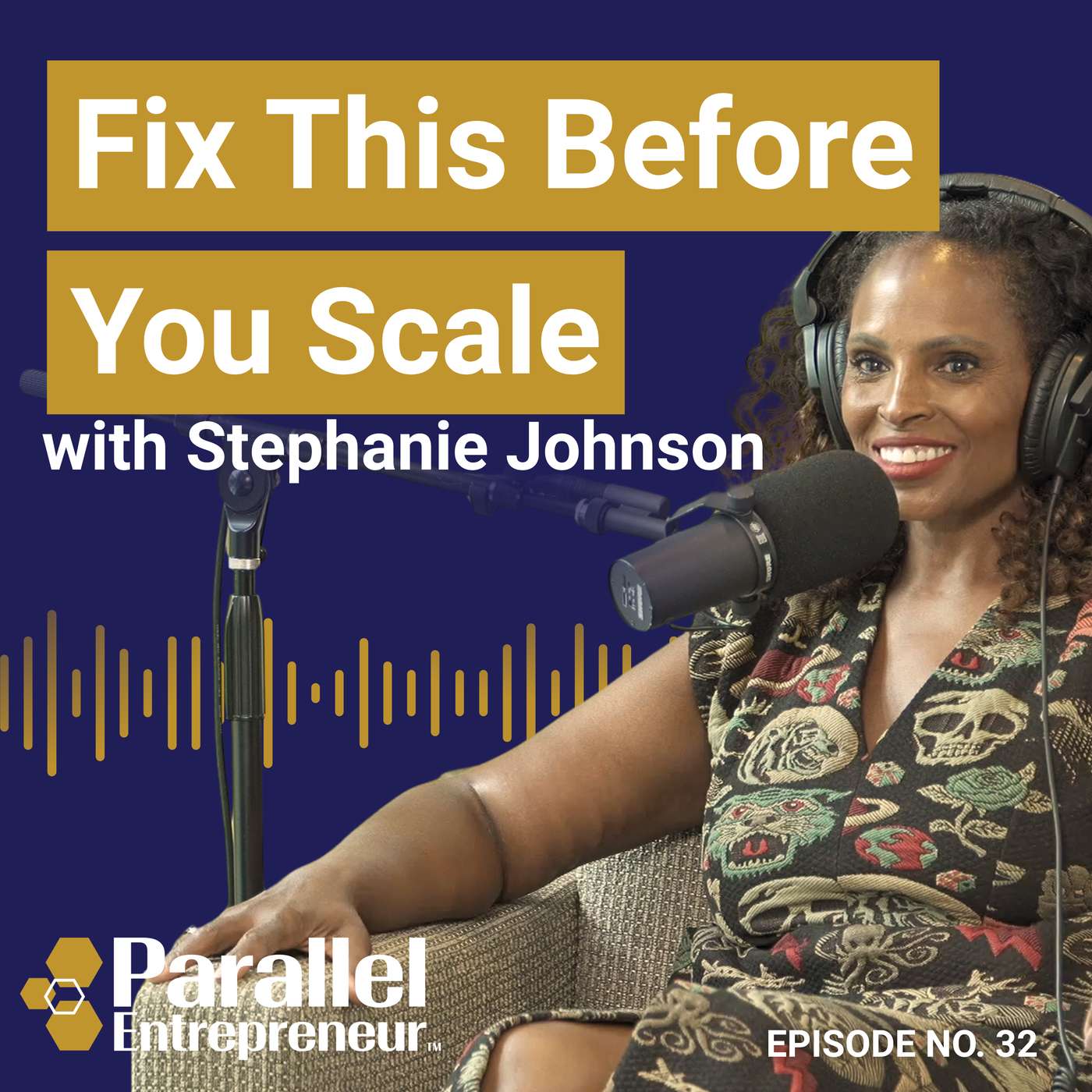
Episode 32 · Stephanie Johnson

Operational Debt Is Slowing Your Company | Stephanie Johnson

Parallel Entrepreneur with Mark Cleveland · Episode 32

0:00 / 6:57
Operational Debt Is Slowing Your Company | Stephanie Johnson
0:00 / 6:57

Episode notes

In this episode of the Parallel Entrepreneur – Innovation Series, Mark Cleveland and Johnny Anderson sit down with Stephanie Johnson, a fractional CEO and COO who specializes in helping companies eliminate what she calls operational debt.

Most leaders recognize technical debt in software. Fewer realize the same concept exists inside organizations.

Misaligned teams. Unclear processes. Decisions that made sense in the moment but quietly compound over time.

Stephanie steps into companies during pivotal moments—growth, transition, or pressure—and helps leadership teams reconnect strategy with execution.

This conversation explores:
• What operational debt actually looks like inside organizations
• Why strategy often fails at the execution layer
• How leaders stabilize teams during change
• The hidden friction slowing growth
• What it takes to realign people, systems, and performance

If you’ve ever felt like your business should be moving faster than it is, this conversation will resonate.

About the Stephanie Johnson
Stephanie Johnson is a fractional and interim CEO/COO who helps organizations navigate complexity, stabilize operations, and drive sustainable growth. Known for her ability to quickly assess challenges and reconnect strategy with execution, she works with leadership teams to improve performance, strengthen alignment, and eliminate operational friction. Stephanie has led across global teams and organizations, bringing a balance of operational rigor, executive leadership, and people-centered transformation.

About the Hosts

Mark A. Cleveland
Managing Director at Kensington Park Capital, entrepreneur, M&A advisor, and host of the Parallel Entrepreneur Network
Follow Mark on LinkedIn

Johnny Anderson
Nashville tech leader, GNTC board member, Entrepreneur-in-Residence at the Entrepreneurship & Innovation Center, and host of The Impodsters™
Follow Johnnyonbrand on LinkedIn

Links & Resources

👉 Learn more about the Entrepreneurship & Innovation Center (EIC):
wcs.edu

👉 Join the Parallel Entrepreneur Network:
parallelentrepreneur.com

👉 Subscribe for more conversations with leaders building aligned systems across business, education, and community.

👍 If this episode resonated, leave a comment or share it with someone shaping the future of leadership.

Chapters
00:00:00 The idea of operational debt
00:00:44 Episode introduction + Stephanie’s leadership focus
00:01:10 What operational debt looks like inside companies
00:02:05 Why strategy often breaks at execution
00:02:58 Stepping into organizations during pivotal moments
00:03:47 Aligning leadership teams around clarity and accountability
00:04:39 Finding the friction slowing growth
00:05:26 Stabilizing teams during transformation
00:06:19 Reconnecting strategy with operational discipline
00:07:12 Leadership lessons from high-stakes environments
00:08:05 Final thoughts on eliminating operational debt

Chapters

  1. The idea of operational debt
  2. Episode introduction + Stephanie’s leadership focus
  3. What operational debt looks like inside companies
  4. Why strategy often breaks at execution
  5. Stepping into organizations during pivotal moments
  6. Aligning leadership teams around clarity and accountability
  7. Finding the friction slowing growth
  8. Stabilizing teams during transformation
  9. Reconnecting strategy with operational discipline

Full transcript

I've been in roles as a COO where they're like, oh, but you don't know how to be a you're not a data analyst. I don't need to be a data analyst. it's about the people. It's about how you make them feel. And will they follow that? Will they believe in that? How do you make them feel about the safety of of failing or the safety of bringing up ideas that may not be super popular? Like, I feel that I've created that environment, that I continue to work on that environment and I want everybody else to do the same, because that's the key.

The solution doesn't lie with me. Right, I lead an organization. The solution lies in every developer, every marketer, every customer success - they have ideas. You just have to find a place for them to to lay them out.

My name is Stephanie Johnson I'm the CEO of Acklen Avenue. I've been a COO for a while, and so to me I'm in the back of the leader I'm supporting the leader from behind the scenes. And that's where I was and I was okay with that, because I love being a COO because they know everything. They can see things ahead of time, that foresight that like being able to put things together ahead of most people, right.

To keep us from getting into a bad spot. But Nashville is welcoming, it's a welcoming place and since I become CEO a year ago, yesterday actually, a year ago yesterday I was appointed CEO. It's really even opened up even more for me, and people have been welcoming. Because it's a different role, CEO is doing different things than a COO, but I would advise that most CEOs need to be COOs first.

We're here to talk about technology and innovation, and what we end up talking about is people stuff, It's always people. People stuff right. Yes. So what is maybe the, what's one of the biggest lessons you've learned recently? We talked about this a lot. You have to provide clarity to your team, from the top down. And once you can do that, once they can understand where you're coming from and the vision, and like you know just clarity.

Like I think one thing that I left out of here with an idea of what I wanted to do, and I was so gung ho about it. I was like let's like, I wanted a meeting the next day, I was like let's talk about this I am so excited. When I got back to the office to tell my SLT though, they were looking at me like I was completely mad and crazy. I didn't have.

You just got back from a Tony Robbins seminar. Yes. Now you're crazy. I'm I'm hyped. When's this gonna wear off. So I mean, but it wasn't their fault it was mine. And it's like I had to provide clarity of what I was thinking of, and they would help me with the rest. But as long as I made them feel comfortable, and you always, there's a psychological part to rolling out anything and especially now with AI, right. There's a lot of psychological things, you have to make people feel comfortable that we're not replacing you. Like they have to be part of the solution, they have to be part of us getting here. And my whole entire team is part of the reason why we are prepared today.

Wow mic drop. That would be the end of a normal session, but for this this isn't normal at all this is so exciting. You have the ability to communicate an excitement and I just keep I keep listening to your voice, and hearing the spirit that's in there and I wanna follow you too. So where do where do people find you, and follow you? Yes.

LinkedIn, I'm on LinkedIn like everybody else, that's probably the main main place. I don't have any secret websites, or social media accounts. But like LinkedIn, I'm on LinkedIn you can reach me anytime. And the thing is like you cannot, it's authenticity for me, this is what you get every day. I've been to people's homes met their husbands or wives and I think they're all like is she like this all the time?

I'm pretty much like this all the time, sometimes it may not be just as cheery depending on what's going on. But you can't, I'm very if you feel it, it's because I feel it. And so that's what I want, is like I'm telling you this is I'm very excited about it. And anything that I, any initiative that we come out with I I bring that when I'm when. Because I really truly feel something about it and I want people to do the same thing if they feel strongly about something. You'll know, you'll know, because you can listen to their voice and they, and how they present the idea and all of those things so, thank you.

It's true, it's a true feeling. I've listened to podcasts and I've heard a statement that kind of falls under the category of AI is going to allow us to do more human things. That always sounded a little silly to me and I don't know that I fully understood what that meant. You made me feel that in the way that you answered that question, I think I'm getting a better inclination of what that actually means.

Some of it's very much people stuff, but I think that was the the first, that was an aha moment I just had with you. Well that's amazing, it's all about people, I think that's where, you know, I'm a non tech I'm considered a non technical CEO. Whatever that means, I kind of I don't like the phrase non technical CEO. But I have been in roles as a COO, where they're like, oh but you don't know how to be a, you're not a data analyst.

I don't need to be a data analyst. It's about the people, it's about how you make them feel. And will they follow that. Will they believe in that How do you make them feel about the safety of of failing or the safety of bringing up ideas, that may not be super popular. Like we create. I feel that I've created that environment that I continue to work on that environment and I want everybody else to do the same because that's the key.

The the solution doesn't lie with me, right. I lead an organization. The solution lies in every developer, every marketer, every customer success. They have ideas, you just have to find a place for them. To lay them out, and talk about it. Express it. Yes, and some of those are gonna be great, and some of those are gonna fail, but that's okay too.

Well there might be incremental movements towards a massive success, I hope so. Congratulations, thank you for coming today. Thank you guys for having me, thank you.

Building more than one venture?

The Parallel Entrepreneur Network is a private, vetted community of founders running multiple companies at once. New to the idea? Start with what a parallel entrepreneur is.

Apply to the Network

← All podcast episodes