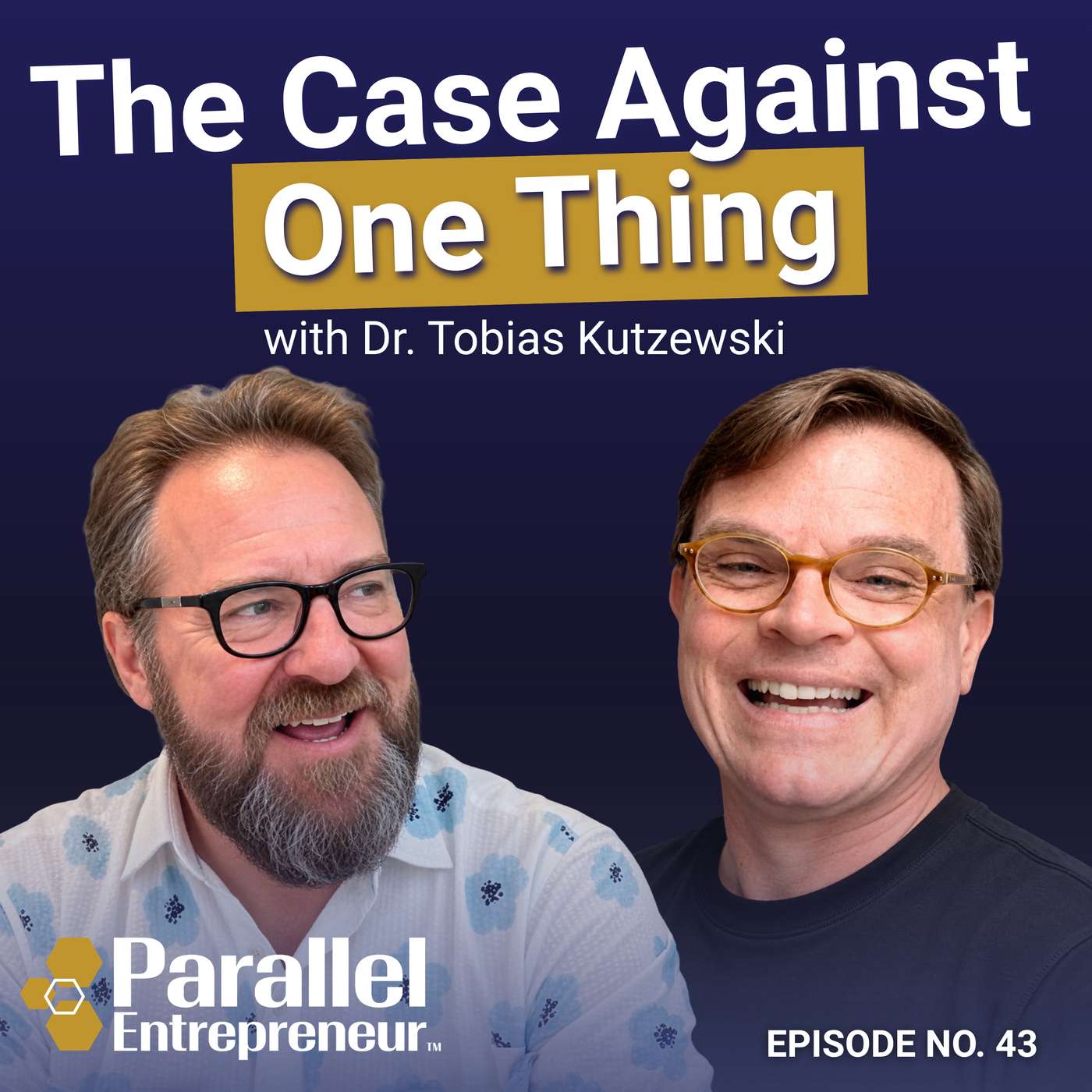
Episode 43 · Dr. Tobias Kutzewski

The Science Behind Running Multiple Businesses at Once | Dr. Tobias Kutzewski

Parallel Entrepreneur with Mark Cleveland · Episode 43

0:00 / 1:01:53
The Science Behind Running Multiple Businesses at Once | Dr. Tobias Kutzewski
0:00 / 1:01:53

Episode notes

What if running multiple businesses isn't a failure to focus, but a different way of operating altogether?

Dr. Tobias Kutzewski has spent years studying entrepreneurs who build and manage multiple ventures simultaneously. His research followed 21 entrepreneurs over time, examining how they allocate resources, respond to uncertainty, recognize opportunities, build teams, and decide when to explore something new while continuing to operate what they already have.

In this episode of The Parallel Entrepreneur, Mark Cleveland sits down with Tobias to compare that research with Mark's own experience of building multiple companies throughout his career.

They explore strategic optionality, the ability to prepare for and seize opportunities you cannot necessarily predict, and what happened when Tobias's research collided with the enormous uncertainty of COVID-19.

The conversation also gets into one of the biggest assumptions surrounding entrepreneurship: that focus must mean doing one thing.

In this episode
• What separates parallel entrepreneurs from serial entrepreneurs
• Why Tobias began studying founders running multiple companies
• What "strategic optionality" means in practice
• How successful founders divide their time, capital, and attention
• Why knowing what you don't know is a critical leadership skill
• The role of trust and talent when managing several ventures
• What Tobias observed when COVID-19 disrupted the entrepreneurs he was studying
• Why some founders become more opportunistic during uncertainty
• Mark's "pause, pivot or pursue" decision during the pandemic
• Whether resilience can be developed
• Why the economic impact of parallel entrepreneurship may be larger than we currently know
• Why younger generations may increasingly become parallel entrepreneurs

If you've ever been told you need to choose one business, one idea, or one path, this conversation offers another perspective.

About Dr. Tobias Kutzewski
Dr. Tobias Kutzewski is an interim finance director and freelance lecturer at the School of Business & Economics at Vrije Universiteit Amsterdam. He earned his PhD in entrepreneurship researching how parallel entrepreneurs initiate, develop, and coordinate multiple ventures over time. He is also the co-author of Strategic Optionality: Pathways Through Disruptive Uncertainty.
Follow Tobias on LinkedIn
𝗔𝗯𝗼𝘂𝘁 𝘁𝗵𝗲 𝗛𝗼𝘀𝘁
Mark Cleveland is an entrepreneur, investor, and advisor who works at the intersection of multiple ventures. As the voice behind The Parallel Entrepreneur, he explores how founders build aligned businesses, strong teams, and sustainable momentum without forcing themselves into a single path.
Follow Mark on LinkedIn

Subscribe to The Parallel Entrepreneur for conversations with founders, researchers, and leaders exploring what it takes to build, lead, and thrive across multiple ventures.

Learn more about The Parallel Entrepreneur and our growing community at parallelentrepreneur.com

𝗟𝗶𝗻𝗸𝘀 & 𝗥𝗲𝘀𝗼𝘂𝗿𝗰𝗲𝘀:

Follow Tobias on LinkedIn

Strategic Optionality: Pathways Through Disruptive Uncertainty — Surja Datta & Tobias Kutzewski

Explore Tobias's research at Vrije Universiteit Amsterdam

Unlocking Strategic Innovation: Competitive Success in a Disruptive Environment — Surja Datta, Sandeep Roy & Tobias Kutzewski:

Follow The Parallel Entrepreneur on LinkedIn

Learn more about Mark Cleveland:

Happy Overall:

Related conversations
Why Founders Don't Succeed Alone — Dakota Simpson on the systems and support behind the rising generation of founders
Scale, Sell, Repeat — Roger Brown's repeatable playbook for building and exiting multiple ventures
The Comfort Trap Every Entrepreneur Must Escape — Joe De Sena on building the resilience that carries founders through uncertainty
Chapters

Full transcript

The younger you are, the more likely you are to be a parallel entrepreneur, either right now or real soon. I've heard it said to me, "Wow, how do you manage the chaos?" Well, what would happen if it's not chaos? What would happen if it's highly organized, passion-driven, resource allocation made sense. Individual leadership skills, I would say, are probably the most important component actually to understand what makes parallel entrepreneurs unique. I see so many people get up against a block and just stop most of the time talking themselves out.

Obstacle is not something fixed. It's something that changed. So your perception of obstacle change might also provide you with some possible solution or at least well a number of potential [Music] directions. Today's guest is Dr. Tobias Kutzewski, researcher, strategist, finance leader, and someone who has spent years studying a question that many founders are actively living.

That question is, what really happens when you build more than one venture at the same time. He's based in Amsterdam. Tobias researches how entrepreneurs navigate uncertainty, how they manage multiple opportunities, and make decisions with their time, capital, and attention. how they're constantly stretched across competing priorities. What drew me to Tobias's work is that he's exploring something we talk about a lot here on the podcast. Not serial entrepreneurship, but parallel entrepreneurship. And in his words, portfolio entrepreneurship. The reality is that many founders aren't leaving one thing to start another. They're building interconnected ventures simultaneously.

In this conversation, we'll explore tension between focus and expansion, why uncertainty can create opportunity, and how entrepreneurs manage complexity over time, whether running multiple ventures actually creates resilience or just more Chapter 2: What is strategic optionality? chaos. I feel like I haven't had the time yet to fully understand strategic optionality. How would you explain it to the audience? Well, the idea of strategic options or strategic optionality actually rests on the assumption that we can't foresee the future. Well, essentially future is unknown to us, uncertain. We don't know in which direction things are developing which essentially requires us to

anticipate things that might come up that we do not foresee that we do not yet know at this stage [Sighs and gasps] um but that might fundamentally affect the way we work the way we operate our companies are run everything. So it's actually the idea of having something like if you want to a toolbox of well means ways to well to get things done in the future. And not only in hypothetical terms, not only that we think about how things might go on like a scenario or planning that we make um to to work, but also actually in doing already something um like setting up a small working group

or well uh make a strategic investment in uh in a startup or a number of startups. Well to be able to once future is unfolding and we see into which direction a certain market um is developing that we are then able to grasp these opportunities that are there in those in those areas. Um and it's actually the I think the beauty of this idea of strategic optionality actually is that we say well even if we do not see and are unable to anticipate and forecast the future we are still able to benefit from something that might be worthwhile to pursue and to grasp everything that our future provides us with. I think this is I think it is uncertainty that is underlying this idea and to cope with that. Chapter 3: Recognizing vs. seizing opportunity

So your baseline is uncertainty and you're trying to evaluate whether the decision maker in this case a parallel entrepreneur has the skills, the resources and the tools to address the now when that's presented to them because it was unknown previously and now it's an opportunity or now it's an option. Is this about their capacity to seize it or is this about their capacity to recognize it?

I think it is more their their ability to seize an opportunity instead of well anticipating something because in a very early stage you do not yet know if well a certain venture opportunity is commercially viable. Um also well we cannot foresee into which direction certain uh business ventures are developing [Gasps] and as such we have to recognize and acknowledge our limitations in terms of knowledge um capacities resources everything that comes into play and once you well see opportunities emerging I think seizing them is what basically distinguish someone from being effective in the long term compared to somebody

who is just well having some luck with developing some new ventures in a rather unstructured way in a rather unstructured way. So you think it's about the structure that's applied to seeing and seizing opportunities? Indeed. Indeed. And I think there is a certain well if you want to say in certain element of well let's call it learning being able to uh acknowledge that your count understanding of a certain market sector for instance is um not complete and it will never be complete because while things are changing and you might be working in a certain area for decades. This does not well mean that this industry sector might not change or drift or evolve in a certain direction that you did not yet anticipate. Then

then this reference that might be uh not familiar to you, but I remember growing up in and in 1972 there was a an animated television series called Around the World in 80 Days. I'll never forget the the the main phrase uh that was used by by the main character was the motto of the wise is be prepared for surprises. Brilliant. Lovely indeed. And I think this is this humor or let's say this little bit of an ironic undertone is what makes it so intriguing, isn't it? I mean you can't prepare for everything but well be prepared to encounter something that you did not yet well prepare before. So yes that's beautiful. Chapter 4: Why Tobias began studying parallel entrepreneurs

What made you decide to follow 21 entrepreneurs for an extended period of time in order to make that your thesis and your area of expertise and your study? Basically comes down to an experience or a number of um successive experience I had once I worked at a venture capital firm. Um I have a background in uh financial management. I'm a certified accountant and I was always working in in um well finance functions and as an investment and finance manager for this venture capital firm. I uh received occasionally proposals um to invest in their ventures from well business people who would qualify as

portfolio or parallel or multi-entrepreneur. I mean the wording is uh I think is doesn't make such a huge uh difference. It was always were people who did more than one thing at the same time. And we had the policy at this venture capital firm to refuse um venture investment propositions from um startup founders who had multiple ventures running at the same time.

because of course we wanted to have a dedicated entrepreneur, dedicated team on um on a startup um once we were considered this as a valuable investment and um that was rather surprising to me because I saw occasionally seeing proposals from parallel entrepreneurs, portfolio entrepreneurs who were well intriguing, fascinating that that good track record.

They made sensible assumptions. Um, essentially I would say well it is it would definitely be worthwhile to consider um their proposals as a well potential at least as a candidate for future for future interviews but um as I said we had this policy to not well include them in our investment funnel. At around the same uh stage I uh saw an advertisement here from a local university that they offered PhD to part-time practitioners working uh already and to conduct the research well parallel next to their professional work and here we are excellent indeed

10 minutes[Clears throat] came out that well actually this phenomenon that I was not yet aware of parallel entrepreneurship portfolio entrepreneurship was something that well was was a concept in uh in business schools that um at that stage deserve and got some some growing attention because strangely enough those people were doing quite well but they were not yet addressed as being um very specific or very unique in their well economic contribution or way they organize or coordinate their their affairs. And I thought well this might actually be

quite an interesting topic to um to conduct my my research upon. And then I really just got blessed by the opportunity to follow those 21 entrepreneurs in the end um over a number of years and well yeah ask them, follow them, see how they organized, coordinated, orchestrated their um their their ventures over several years and how things changed, how their attitude, how their interests, their intention changed and what factors there were to will basically organize and structure portfolios the way they did. Chapter 5: Parallel vs. serial entrepreneurship That is precisely what I've been trying to get at uh now hundreds of interviews with entrepreneurs and sorting through

who's a parallel entrepreneur and who's a serial entrepreneur and um let's honor every entrepreneur but let's also try to dive into this area of study. It is what definitely distinguishes parallel entrepreneurs from all the other form that we have. The serial entrepreneurs who do uh develop their ventures and companies um after each other. Nent 12 minutesentrepreneurs who do it at once and once in a lifetime and try to develop their their individual ventures. Portfolio entrepreneurs well have an opportunity.

They can either say well I do want to develop what I have at the moment. I mean it all starts with being a nent entrepreneur. At one stage you have a company that is either doing well, prosperous or not. And you might change well do I going um into the same direction? Do I want to exploit what I do currently have or do I want to explore new ventures, new avenues? And I think this decision between exploitation and exploration is what makes um portfolio entrepreneurs so unique because they do have the opportunity identify for themselves to do some either opt for doing more detailed spend more detailed

efforts on their existing activities or to well venture into the unknown and say Well, I do keep the other uh companies still running and alive, but I see another opportunity or a way to mitigate my current risks or to um identify a joint venture to somebody else as a way to I would say to bring their own intention of opportunity seeking um to capitalize on abilities on resources into life. And I think it is this very personal um intention that uh distinguish habitual entrepreneurs like serial and uh parallel entrepreneurs but

in particular parallel entrepreneurs because they do have um the idea and their understanding that it might be quite effective to have more than one company at the same time. It gets tricky. I mean I probably don't have to explain it to you. you are a seasoned parallel entrepreneur yourself. You know how difficult and challenging it sometimes can be to have more than one uh responsibility to juggle. But still there are benefits and I would say that these ability to know yourself your capacity to actually orchestrate those different well let's say challenges or requirements. I think this makes uh parallel entrepreneurs unique compared with others. Chapter 6: How Mark manages attention across multiple companies

Let's pretend that you and I are working together, Tobias, and we're on on the same team trying to accomplish something in a company that that I've started. I might walk side by side with you for an extended period of time [Clears throat] and then get to the point where the trust and the confidence is there and I I reach this decision point where I'm 15 minuteslike, "Okay, he's got it. I'm out of here." And I really literally I've been told this by people who criticized me over the years or contributed to my identity uh and my understanding of this behavior of my own. Anyway, I'm not saying it's everybody's. I'm just saying I would walk until the trust and confidence was was jeieved and then I would go up to 30,000 ft and operate

there and then after a period of time I would drop back down to treetops check in with you check in with all the systems uh inspect and then I trust and confidence is still there let's move and I'm out of your way uh here's a direction that we're headed and I retreat back up to 30,000 ft and it's this context switching I call it but it's a different form it's a drill down it's a drill down understand gain um gain perspective and context and then disappear so that I'm not in your way um and I I don't have anything else to learn now it's time for you and the team to execute and I for me as a parallel

entrepreneur I found that to be helpful because I can drill down on company a spend the time necessary, find ways to collaborate. I could be called down from wherever I'm at 30,000 ft or 10,000 ft. It's a metaphor. Wherever my attention is, I'm trying to maintain a wider perspective on the marketplace and on what's happening. And then pay my deep dive attention when it makes sense on a calendar, on a schedule when it's necessary, or when I'm called.

Beautiful illustration indeed. And I think it is this ability for yourself that you know that you are able to not only well execute your own expert knowledge on certain areas like these T-shaped uh personality type that we that we sometimes uh identify people with a very profound detailed deep knowledge of let's say marketing knowledge, sales knowledge, uh technical skills They make it they make those people extremely valuable at certain stages of a life cycle but their ability also well to then take a step back and not only one but really zoom out take the overall few and being willing and able to well

then let the team run the affairs and um I spoke once with a with an entrepreneur um a parallel entrepreneur himself about how he is going to to coordinate his uh companies and he simply said well it's just I can I can do a lot by myself I can't do everything and I do need people I do the need the people around me to trust and to actually do the work and I thought this was very humble actually in his expression to say well yes you can identify um tremendous opportunities in the market um run and initiate initiate a startup but in the end it is something that you have to

well give out of your hands and say well other people are maybe better equipped than myself to develop this venture further and I think this was to me um the idea where I thought oh there's a very yeah let's say social element in it a very profound well ability to understand your own ability ities but also the abilities of others and see how to utilize them and bring them in line with what you what you have in mind. So, I view myself then as a talent tracker. Chapter 7: Finding and deploying the right talent And when I identify highly talented people in my universe, I not only appreciate them and hope that someday I'm going to get to work with them, but I'll pay attention to where they are, how their career is progressing, if they're available, if they're not

available. If I have a company that's coming up in in my own rearview mirror and it's it's looking like it's going to require some additional talent, I might know where that talent is already. Um, so I want to talk about how do parallel entrepreneurs identify, deploy talent in their organizations if it's different, if it's the same or if it's just well I'm doing the same thing twice, three times, four times. What's your experience? You have to know where your own expertise rests. What do you what do you know? And probably even more important, what is it that you don't know? And I think that's what I also saw uh from my own um

personal experience as a I was a startup coach here for an incubator at our local university. And I think it makes a huge difference between a successful and a less successful entrepreneur to know what areas you are not well at uh at an expert level. And if this is for instance recruitment um HR uh developing and acquiring talent then this would be an area where you should definitely seek to find someone who is more equipped in this field because I would say well in the end it is definitely um a human resource a talent game that entrepreneurs are in um and you have to

well search for talent that is well well yeah complementary to what you what your own skill set uh comprises. And I would say that the more effective and successful entrepreneurs are those 21 minutesthat are quickly able to identify people who can complement their own skill set either in technical terms, in organizational terms, in creative terms, in indeed talent uh acquisition terms just to make sure that you are not falling short on some of these very crucial and pivotal areas that we have to Well, to bring a brainchild actually Chapter 8: Businesses at different stages of maturity into a into a company as a startup coach, what you'd know is if I've got six companies, one of them's

a startup and maybe another one is a an adolescent and another one might be a a senior in high school by the comparison, right? and another might be something that we're harvesting and and u it's got a mature management team and a mature market and it's behaving they behave each one of these companies behaves differently um your talent funnel your view to talent and what the business needs is is something that I think uh it helps if you've had many of those experiences and you understand where the company is if you can really truly map that did you see in your experience all people who had several startups at once

or did you tend to see them have startups on a cadence? What did that look like? In the end I came around um Chapter 9: Different types of parallel entrepreneurs well number of instances where really the structures that people were uh developing in the portfolios showed some well very distinctive characteristics and we had for instance the let's say the haphazard entrepreneur who is doing something here and venturing something there completely unrelated um also no real well connection in terms maturity of a venture and it was more like an ad random uh game that that these people were playing and not unsuccessfully. Yeah, they may were still doing quite a quite a decent um

uh uh trajectory that those people pursued. We also saw that there were instances where people well either chose to well dedicate their most efforts on an existing family firm and explore other adjacent areas through strategic startup investments and also as a mean to well to keep their well younger generations uh interested in their in their um business. So, it's like a talent, it's a talent retention strategy. If I want to keep this family member who's talented involved and engaged, we're going to we're going to splinter off an opportunity here and let them really run with it. Uh that's like talent retention.

It is. It is. and development also it's that they provide well your well own children uh children-in-law partners with the uh opportunity actually to develop to develop some world business accumment and understanding of prayers and I would not necessarily say that you do need um startup knowledge well to be able to well successfully uh become the inheritor of a family firm but at least it provides you I I would say with a very good area to develop yourself and to distinguish yourself amongst other peers. And yeah, I saw that this is one of the ways that actually uh parallel entrepreneurs do well then intentionally explore into startup ventures. Um

software technology firms for instance where their main family business was something in name it manufacturing or well more of an old school industry area. So I think this is something where where the intention of entrepreneurs comes into play. What is it actually that you want to pursue with your why uh essentially do you do more than one one thing at the same time? Chapter 10: Happy Overall My friend Brandon shared a piece of advice recently. Dress so that if someone dressed up as you for a costume party, everyone would know it was you.

Now that's not entirely about clothing. That's about identity. about showing up fully. My wife Jenny and I are leaning in on this concept both in our personal lives and now in a little startup we call happy overall. We're making overalls. Each one is made to order as a wearable canvas for art. Overalls that are comfortable, durable, and expressive. We're sourcing soft 100% cotton. We're partnering with designers and with local seamstresses who love the artistry of a well-crafted piece of clothing. So check out happyoverall.com to see picks and see if anything resonates with you fully you and it'll

happen every time you reach for them. If you want to be part of the first run, join our waitlist at happyoverall.com. Chapter 11: Is entrepreneurship a game? I heard you use the word game just a second ago and I wanted to drill in on that. I have some parallel entrepreneur interviews and experiences with uh I'd call them peers who look at their business and I think it's a coping skill. I but but they look at the business and what they do as a game and there are rules and they want to level up. So they spend time imagining what do I need to learn? Which company am I going to experiment with on this particular area? You know, in first-person shooter games like my sons

play, there's probably a moment where they get to win this special double-sided sword with superpowers. They've got to go win that sword and then they can use it in all of their various different levels. So when they when I hear other entrepreneurs speak about their business experience as if it's a game, I think it also helps them uh not only prepare but seek a goal and have that goal serve other goals. And as they level up, they're moving from a mature business to a less mature business to capture some experience or experiment and then see how they can apply that to the next opportunity within their portfolio of companies. How does that resonate with you as an observation?

One thing where I definitely agree and one element where I would say um there might be a minor adjustment actually to the idea of a game. Well, the first one is we definitely agree is that people do see the joy, the pleasure of doing 28 minutessomething. And I think your son um yeah, if you if you say, "Well, now it's time to turn off your PlayStation or whatever device he's playing on," he will definitely say, "Well, just five more minutes that right, please. I'm just It's going so nice." And [Clears throat] you're not quite there. Wait a minute.

And it is I think this joy this very personal emotion that you see that drives I would say entrepreneurs more than most people. I mean we do of course see that with with managers with um probably also in academia people they are intrinsically motivated to do something that they do derive deep pleasure from what they do. So I think this is definitely the game the fun side of um of seeing this metaphor of a game. On the other hand, I would say it's sometimes difficult to understand the idea of a game. [Gasps] Uh because in real life maybe the rules, the incentives, your competitors in a game change

without you knowing what's actually going on. And then once I play um uh chess for instance, a pawn always moves the same way. And I do definitely know where the board ends when I play chess. In real life, I do not always know where the area where the industry is changing or heading to. Isn't that exciting though, right? Isn't that exciting? That's what makes life for yourself that the uh what you once took for granted in terms of well these are the rules of the game maybe they're not not well maybe they were there yesterday and maybe today but who knows how the rules of the game are tomorrow. Chapter 12: When the rules suddenly change I had one example for instance um that's it's maybe interesting to illustrate that because as I said well I was able

to follow those entrepreneurs over a number of years and um it was well a couple of years ago that 30 minutesum COVID-19 of course emerged and this brought a fundamental shift to uh to the way people worked and with a particular the first lockdown here in the Netherlands in Europe brought brought well unprecedented uncertainty to people. Um, no one knew into which direction certain areas were heading and if there well like for instance how how a restaurant chain or hotel chain would would come out of those of this this period and strangely enough you saw um a

few entrepreneurs parallel entrepreneurs who shifted their mindset completely in the beginning. Well before corona they were consolidating uh saying well I have to to reduce uh my explorational activities. I want to consolidate on what I have want to de develop my companies further and some of them well said this is a crisis too good to waste.

I have to explore into new directions. I have to acquire competitors because now they are this is the way for me the opportunity the moment that comes once in a lifetime. And it was I thought, "Oh gosh, this is surprising because they really were driving uh and and and flourishing in this period where others really were concerned and said, well, I I don't move. I don't dare to do anything. I just keep my keep sitting on my hands. Don't do anything." And I think this is a very personal, very private, very let's say intrinsic moment that entrepreneurs have. How do you what do you do once you realize for yourself that these rules of the game are

changing and surprises coming on and and uncertainty is actually well the the new rule of the game, right? How I was I was curious actually what did what was your experience once COVID-19 emerged in the US? How did you cope with that? I had Chapter 13: Mark's businesses during COVID-19 the good fortune of having one company um that exploded. Swiftwick compression sock manufacturing company uh was being run by some competent people and I had become from a founder CEO to an investor. Um and and they they just exploded 30% a year. Everybody was at home buying sports athletic socks and getting out and running and taking better care of themselves. Uh, I had another company that I was paying more attention to, a startup that um, gee,

going into the the March recognition in America when when the shutdown happened, I was operating a company that was a technology company, doing shared mobility incentives, paying people cash for sharing rides, and taking public transit in a mission to try to reduce congestion and environmental damage. uh that auto emissions and driving alone represent. And gosh, I I think we made more sales in the first quarter of 2020 than we had the previous entire year. It felt like we were just absolutely crushing it. And then the shutdown came and we were literally the entire market evaporated. Nobody wanted to be in a car with anybody else. I

was very conflicted. I had probably 30 globally recognized world-class advisers Chapter 14: Pause, pivot or pursue? um investors from a lot of different disciplines. Uh I asked them in the case of Hytch I said uh should we pause, pivot or pursue? That was the question. Um I'm seeking advice. And I think my reaction might be that I became much more open to advice. I became much more coachable. And also this was a confusing moment because uh I got about one-third of my advisers said pause it's over with this is the end of this business you know hang it up and one-third of them said pivot move to a diff use this technology you've developed and apply it to a different space and one-third of them said pursue it your your vision your mission and your objectives are

clear and we we invested in you for that reason pursue it so um I did a little mixture of all three, you know, I I I I pulled in the horns. I re-evaluated the technology. Instead of changing its application, I doubled down on the things that we thought were important um but might have had more short-term value and and yet we're still on the product plan. And I also just pursued the vision uh relentlessly. I probably should have quit. I probably should have gone back and said, "Yeah, pause was the win. Kill it." And that's one of the things that I feel like I've learned in the pandemic was I think that not knowing when to quit is a weakness as much as it might

be I never quit is a strength and uh so that's what I learned about myself. Those were some of my experiences in the pandemic but it it forced me to evaluate uh the real estate much more carefully than I had before. Would you describe just a perfect example of how Chapter 15: How entrepreneurs make decisions under pressure people who do have different requirements surrounding them and different necessities to to cater to are then required to make it to make in an instant moment a decision and not only a decision for themselves but a decision to [Gasps] well to to that that works for their employees for their investor. ers for

all the numerous stakeholders that you probably feel deeply responsible for. Huh. But I still think in those those moments how we do have this small part in our brain, the amygdala that that responds instantaneously to exogenous shocks this fight, flight or freeze response that we we will frequently uh refer to. you. I think there is a certain element of truth in uh in this very bodily um form to to respond to events that are well surprising to you. And I would say that uh COVID-19 and these in particular the very early phase was

something where this response intuitively um revealed quite an great part of what will distinguish a certain person and how he or she organizes and works with with others. And um I see it for myself and because I can only share this this moment when uh I was sitting here in uh in Amsterdam in the Netherlands with my uh wife and kids and we were uh watching the broadcast that the Dutch government was announcing the the lockdown, the shutdown few days later and it was uh still remember it was uh March the 12th uh Thursday uh afternoon and next day Friday the 13th, I was uh in the morning

eagerly um compiling a short questionnaire that I could send out to my uh portfolio entrepreneurs and ask them what they would do now because I thought this is such a wonderful moment for me to to well to grasp the moment which was still unbelievable because it was horrible, right? What was going on there? But to me my most intuitive response was just this is too too good to be true. I have to grasp every opportunity that comes up with. And yes, one of the papers um actually that I was 38 minutesable to publish uh based on my uh PhD dissertation covers exactly this short moment in time. this well what do entrepreneurs do normally but in particular what do they do once COVID-19 comes up and this was Chapter 16: Studying entrepreneurs through COVID-19

unprecedented of course so you already had your portfolio your parallel entrepreneurs identified you already are tracking them you're looking at their finances you're looking at their decision making their resource allocation policies I I'm I'm assuming board minutes I mean you're evaluating how a company is run from cradle to grave and There's multiple companies. So that's one one candidate you're evaluating and and measuring. I mean this is a very intimate relationship and this is a academic research project and you've been going in that conversation in that relationship for how long and then COVID-19 strikes and then how long did you track them afterward? What is the time horizon in in total? I was able to to well to

follow uh this group for about um well it changed a little bit because of course some people started right from the beginning some others joined later. Uh in total it was a almost 3 years so two and a half years and I covered um the immediate lockdown and about half a year into COVID-19. So this is when I then said well this is more than let's say sufficient empirical data that I can um can work with and the unique data was actually um not only the the multiple interviews that I conducted in which I asked both about their retrospective experience the what they currently do and their prospective

experiences around multiple times which allowed me well to yeah critically ask 40 minutesthem to reflect on misalignment on why was it that you're well what you say now actually differs from what you anticipated just half a year ago what what what was it what why why did there something change in your mind um but in particular this moment when COVID-19 emerged and this outbreak gave it a completely new direction and it was such an um acceleration of of the need the necessity um to formal decision making that I thought well this is in itself actually

too good to uh to not be a very important element of my of my research because of course I could not anticipate something like that I was just interested in how do people evolve over time in their decision-making how do they coord coordinate, orchestrate resources and as I said well I'm an accountant so I'm always interested in the formal uh the managerial control systems the way they uh assess investments everything that is well accounting coordinating control related and then with COVID-19 it got into a completely new uh dimension decision-m on the uncertainty if there's one moment in time I would say about the last decades where this became really um a very short element. I think it was the

corona outbreak that that that well forced people to make quick and substantial decisions. Chapter 17: Preparing for black swan events So on some of our more recent episodes, we began a focus on talking about what we call here in America and maybe there as well in Europe, black swan events. And um and then the increasingly normal, it used to be they were every 10 years or so. you know, there was something significant um that you couldn't anticipate and it changed everything. And now I think that the consensus in my conversations is we we have black swan events quite frequently now. Um they they range in scope and scale perhaps, but they they certainly include the invasion of Ukraine, they include the starting of the Iraq war, they they include the

starting of the Iranian war. more recently uh the conflict there uh they include CO 19 obviously they included you know 9/11 I mean if you start looking at the frequency and the impact and the scope of these moments of extreme uncertainty the tariff policy that is affecting global trade did you see a willingness from one cohort or anybody within the group that you could say this is the more flexible more uh rapid decision-making pattern or did you see them all react in kind of a con consistent way to these extreme shocks cuz it's not just been CO 19 there's been other major opportunities that gave them a strategic optionality. uh what

what did you what do you see with regard to just your these relationships that you've you've built over a long period Chapter 18: What makes some entrepreneurs more resilient? of time? How they react in a in a way that can give our listeners maybe some guidance or something to look for within themselves? I would say that this well idea of resilience and uh ability to cope with substantial changes in again these rules of the game uh that we earlier um illustrated. I think it is this form for yourself that comes into into play once you see well this is a very personal uh way to to cope with uncertainty and yes they are

very frequent events that we uh that we could potentially identify as black swans um that we did not well foresee at least well maybe in hindsight we might say well there were some indicators heading into certain say, well, experts in certain areas of course would argue certain uh geopolitical struggles. We're not unlikely to to burst out into into open conflicts or wars.

But still for the majority of people this is not their daily work and we do tend to focus on more of the same of course on in the areas where we think well we do we are able to uh full our days completely uh with with what we have on hand and there are situations where this gets turned upside down and where we have to acknowledge well that uh energy prices are soaring or um indeed for instance Um petrol is becoming something that might well form a certain limitation to our life and maybe we are not able to travel to all destinations uh for cheap for cheap because um yes Iran uh is is currently um a huge

conflict zone but I think this very personal characteristics are something that we're not one dominant um variable is at at place because well age is something uh crucial I would say that once you are well more leaning toward towards your 50s 60s7s and you want actually to hand over or exit your ventures well maybe you are more uh risk averse than you were in your 20s30s 40s is when you thought for yourself, well, there is something, but I can still [Gasps] well run out this struggle uh without any any well harsh consequences

for myself. [Sighs and gasps] Nevertheless, I would say that age or experience and even a resource base itself is not sufficient to explain why certain people are more resilient than others. And I would say that I was pretty much surprised by the fact that some people were to me at least and most likely even to themsel rather rather laidback and cool for instance with coping uh with the COVID-19 outbreak.

And I would even say that probably some people um who are now well faced with the negative consequences of uh the Iran war um Ukraine uh all the defense issues that we currently face here in Europe and the ongoing discussions about that one that brings a lot of uncertainty to people but somehow and this is probably a very personal uh characteristic that people have this tendency to be resilient and be willing to accept that certain things are beyond your own control is something deeply personally infringed and I think it's it's it's fascinating to see um that people do not only well follow predefined script of how they

cope with something or they improve or alter uh the way they they organize their but that they are also able well to rely on some hidden heuristics or rules of thumb and say well h this is maybe still even something that I can can accept and uh where I can live with so I would say resilience itself I'm not sure if people are able to to develop this skill um I was pretty much surprised by the fact how big the variation within the group of power entrepreneurs was and how much yeah let's say flexibility people actually have probably more than um they understand themselves and probably more also more than I was able to identify. I Chapter 19: Mark's approach: observe, accept, act

find a coping skill for me is a discipline that my wife actually introduced uh and I've been able to to try to incorporate into my process and that is to approach everything with the attitude that I'm an observer and then after that obser a set of observations that I I might make in a circumstance I will then accept that as reality what I can see what I can experience what I observe I accept And then I choose if I'm going to act or not. And sometimes choosing to not act is is an action. And acting is is uh something that I may or may not be successful with depending on what I think is the situation. And so uh

after I act, I calm back down or or I just sat back and I observe again what are the consequences? What are the opportunities? what are the strategic optionalities that have just emerged from this decision that was made in the act phase and then I'm going to accept that because that's the new reality and then it's just a it's a one two three four observe accept act accept and then I go back to observing and I feel that that has been um really helpful in my coping or my my definition of resilience as I as I view it in myself. This very much shows how

um an and let's say an active mindset well enables you with coping as you explained but also well grasping the benefits from from changing circumstances right I mean you can of course the way that you decide to maybe not actively respond something can also be an active act of decision-making but I mean in most instances I would say that making an active response to something might probably lead to more beneficial answers um in in changing environments than just wait and see. I mean if we we see it and see it in financial terms as an investor once stock markets crash um a wait and see strategy might actually be more um economically viable than divesting uh everything.

But on the other hand, I would still think that in terms of how comfortable do you feel in terms of your own control and how you are able to cope and respond with changing um conditions and your changing um environment allows you to 51 minuteshave well the mental agility to feel comfortable and at ease with what's going on. And I think this is quite quite uh well great to see and how you illustrate this from my side. Chapter 20: Why on earth do you do more than one thing?

When I was thinking about what what what surprises I found, my first question with all parallel or portfolio entrepreneurs was always this half joke of why on earth do you do more than one thing at the same time? Isn't this actually asking for a headache? And people always responded with this well laughter or only halfway joke of well I'm a little bit crazy.

Yeah, I really appreciate that. Um I've grown up as a parallel entrepreneur. My entire life I've had more than one company at the same time. Most of the parallel entrepreneurs I talk to have that same reaction. It's almost like the whole world thinks we're weird or strange or and we even start joking, yeah, we've got ADD or you know, it's sort of this uh comic response. And in fact, you started out our conversation with a recognition that the investment banking community will take a really great idea and not invest in it. um because this person has more than one company and there that it's this judgment about split attentions and yet

I think as humans we are put together to be creative and weave a complex fabric as opposed to a a specific rope, right? And it it just it's just feels natural to me. And while I know it's not natural for everybody and how they might feel, I think that many entrepreneurs are in fact parallel entrepreneurs and just don't recognize it or don't talk about it or or don't explore it and and we come together occasionally as a group and and are actually reinforcing and understanding and supporting this identity which is sort of the angle that I came at this topic with while you came at it from this completely completely academic perspective. And so for the audience, just me telling my story, I

scoured the world trying to find you, Tobias, to try to find like who has put some thought into and measured what it means to be and feels to be and and might be the superpowers of being a parallel entrepreneur. I'm just thrilled that it's also something that you recognize inside yourself as an intrinsic innate um piece of your lived experience. It's just it might not be a different business at all times, but it might certainly be many different things that you find interest in. I want to drill into something that I heard you Chapter 21: The economic impact of parallel entrepreneurs say earlier, which was the economic impact of a parallel entrepreneur is measurable. And I wanted to get down to

the details. What did you discover there? I started with the idea to to focus on what's the economic return. Why do you do more than uh normal entrepreneurs do? There must be a certain financial wild benefit out of it. Otherwise, it wouldn't make any sense. However, both in terms of in particular regarding startups, their life cycle is very difficult to assess in financial terms over the dur duration of a few years even because most of them are not yet worthwhile. survive not the first years but they have other benefits. For instance, they keep their children engaged in their family business once they are able to develop certain skills that are interesting to uh to deploy in in the startup environment.

Um so to me it became more in terms of or less in terms of an financial um prerogative but more in terms of what do people actually learn? What do they actually do? How do they develop it in terms of managerial practices, leadership practices? Because I thought that this is more well intriguing and probably more effective to conduct research on that one instead of a sole focus on the financial returns. Um having said that does not mean that um I was not well at at least a number of occasions quite impressed by the financial returns they were make they were able to make. Some

of these uh entrepreneurs developed companies um in really in about two years uh exited them because they thought well that now my job is done. I will hand it over to uh to uh professional managers and they obtained a very decent return. This was not part of or this was not the primary part of my research because the limited number of uh those instances [Gasps] but I was still well fascinated and intrigued by at least some of the returns they made. There were some uh comparative analysis done regarding their contribution particularly in frontier markets uh Sub-Saharan Africa where uh parallel entrepreneurship is

basically a mean to mitigate risks because agriculture uh itself is not uh stable enough as an income stream for your extended family. So you have to well diversify into areas where um probabilities are a little bit more uh likely to well provide income for the foreseeable future as well as doing other things. And this was also known that we well we do see parallel entrepreneurship around the globe in different areas. The same accounts for these huge conglomerates, big uh Japanese, Korean firms where everything is uh run under the same under the same umbrella structure, highly diversified

um little bit like the idea of a General Electric in the US. um high conglomerate firms that were well discounted on stock markets for instance because they were too big too huge and say well the breakup value of individual parts of the firm are actually bigger than than the whole. [Gasps] I would say that um what is fascinating Chapter 22: How big is parallel entrepreneurship?

to see about the economic contribution of parallel entrepreneurship is that we do not yet fully know how big this phenomenon actually is. um not in uh in Europe. Um there is this initiative currently going on for um for what we call the uh uh ultimate beneficial owner register. So who is in the end owning a company uh once you're registered at a company house or your local um registering office? So once you incorporate an uh a company this can also be partly of course shares can partly be held by another firm by another company um a trust other forms and once you identify the final person

human person owning a string of um companies then it becomes more interesting to see actually how big this phenomenon is and for the at least well for Europe this is not yet complete completely unraveled because well this uh ultimate beneficial owner uh register is not yet fully incorporated in uh domestic legislation which means that we know that some areas do have probably quite um extensive contribution in terms of uh also exporting activities um the number of patents that are issued by groups that belong to portfolio or parallel entrepreneurs is comparatively big surprisingly. Um we do see that there are some unique characteristics about them but we don't

know how big it actually is because we do not have yet the numbers the statistics available to actually identify uh each and everyone who is under and I think this resonates with what you um said before because some people uh entrepreneurs do in fact explore either adjacent or completely opposing areas um without calling themselves parallel entrepreneurs and they translate or use their skills and abilities in other areas or other ventures or strategic investments. [Sighs and gasps] But this is not always easily able to um extradite from from public statistical data or company data. And I think this

is quite uh quite fascinating to see because not all parallel entrepreneurial activities I think do resonate in measurable data and we see at what at a few in a few markets um that their role is quite extensive but how big it actually is. Um this is one of those famous areas for further research as academic always loves to say and well please do contribute more to this direction. Um but in the end actually this is where we currently are and we do not yet know how big this phenomenon actually is. Chapter 23: The next generation of parallel entrepreneurs I think right now the long the younger you are [Music] the more likely you are to be a parallel entrepreneur today and

or you will be a parallel entrepreneur sooner and faster than you think. Hey, thanks for listening to the Parallel Entrepreneur [Music] and thank you to our sponsors, partners, and the amazing team behind the scenes who help make these conversations possible. If today's episode sparked something for you, be sure to follow, subscribe, and please share it. Learn about our growing community at parallelentrepreneur.com, including details on our mastermind and companion programs designed to help you align, grow, and thrive across multiple ventures. And of course, gratitude to every visionary guest who trusts us to share their story. Until next [Music] time, keep building in parallel.

Building more than one venture?

The Parallel Entrepreneur Network is a private, vetted community of founders running multiple companies at once. New to the idea? Start with what a parallel entrepreneur is.

Apply to the Network

← All podcast episodes