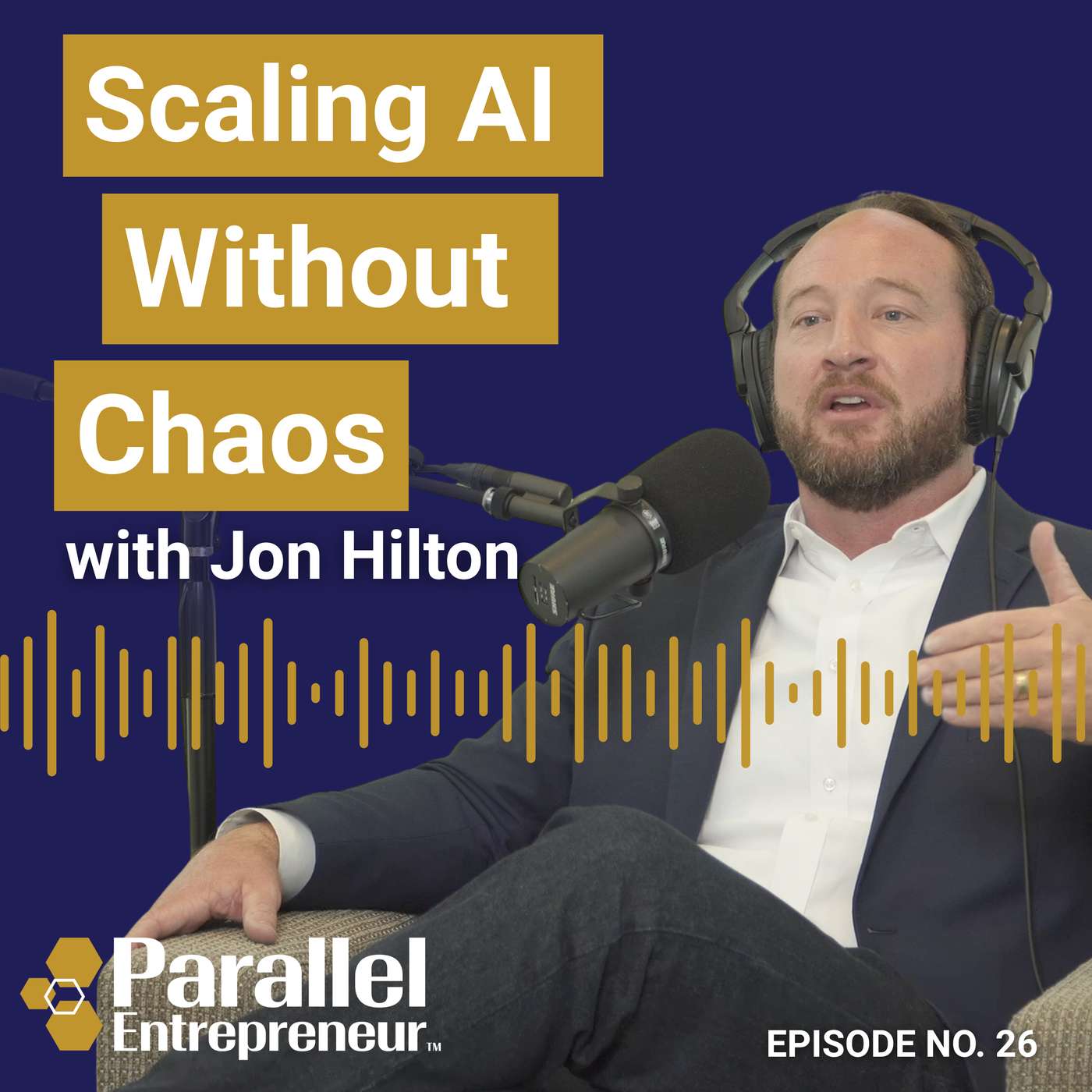
Episode 26 · Jon Hilton

Why AI Strategy Fails Before It Starts | Jon Hilton

Parallel Entrepreneur with Mark Cleveland · Episode 26

0:00 / 16:23
Why AI Strategy Fails Before It Starts | Jon Hilton
0:00 / 16:23

Episode notes

Why do AI initiatives often stall? What does it take to build AI strategies that scale inside real businesses? What does responsible, human-centered AI look like in practice?

In this episode of The Parallel Entrepreneur – Innovation Series, Mark Cleveland sits down with Jon Hilton, Shareholder-in-Charge of the LBMC AI Practice, to address these questions.

Jon brings a rare mix of experience, enterprise data science, large-scale digital transformation, and leadership forged through military service. From this conversation with John, you'll learn:

- Where AI strategy usually breaks down
- How to move from pilots to production without chaos
- Why clarity beats complexity every time
- The leadership mindset required to scale AI responsibly
- This conversation is for executives, founders, and operators who want results, not hype.

 00:00:00 AI Isn’t a Technology Problem — It’s a Leadership Problem
 00:00:40 Introducing Jon Hilton: Leading AI Practice at LBMC
 00:01:47 The Strategy Disconnect: Executives vs. Employees
 00:02:40 West Point + Combat Tours: Leading Through Fear, Chaos & Uncertainty
 00:03:55 Building the Veterans Tech Peer Group in Nashville
 00:04:57 Military Technology + Nashville: What’s Being Built and Why It Matters
 00:06:27 The AI Tool Explosion: Don’t Chase Tools — Define the Problem
 00:08:25 AI’s Expanding Attack Surface: Scams, Security & New Risks
 00:09:42 “In Absence of Orders, Attack”: Courage and Forward Motion in AI
 00:10:24 Avoiding Paralysis: Deliberate Action Without Rushing
 00:12:03 Bringing People Along: Sentiment, Trust & Internal Buy-In
 00:12:55 Leveraging Veterans Well: What Corporate Leaders Need to Understand
 00:13:31 Translating Military Experience to Corporate Value (Network + Skills)
 00:15:10 Closing Thanks & Service Appreciation

ABOUT OUR GUEST
Jon Hilton helps organizations turn AI from an experiment into a scalable capability. As Shareholder-in-Charge of LBMC’s AI Practice, he works with leadership teams to define practical AI strategies, identify where automation and intelligence actually create value, and build systems that can scale responsibly across the organization. A data scientist by training with experience at ExxonMobil and EY, Jon brings a disciplined, execution-first perspective shaped by enterprise environments and military leadership. His work focuses on helping leaders make better decisions about when to use AI, where to apply it, and how to do so without creating risk, chaos, or wasted investment.
Follow Jonathan on LinkedIn

ABOUT THE HOSTS
Mark A. Cleveland — Managing Director at Kensington Park Capital, entrepreneur, M&A advisor, and host of the Parallel Entrepreneur Network.
Follow Mark on LinkedIn

Johnny Anderson — Nashville tech leader, GNTC board member, Entrepreneur-in-Residence at the EC, and host of The Impodsters™.
Follow Johnnyonbrand on LinkedIn

👉 Join the Parallel Entrepreneur Network: parallelentrepreneur.com
👉 Subscribe for more stories from entrepreneurs who thrive across multiple ventures—and live aligned lives.
👍 Like this episode? Leave a comment or share it with someone who leads across lanes.
Chapters

  1. Introducing Jon Hilton: Leading AI Practice at LBMC
  2. The Strategy Disconnect: Executives vs. Employees
  3. West Point + Combat Tours: Leading Through Fear, Chaos & Uncertainty
  4. Building the Veterans Tech Peer Group in Nashville
  5. Military Technology + Nashville: What’s Being Built and Why It Matters
  6. The AI Tool Explosion: Don’t Chase Tools — Define the Problem
  7. AI’s Expanding Attack Surface: Scams, Security & New Risks
  8. “In Absence of Orders, Attack”: Courage and Forward Motion in AI
  9. Avoiding Paralysis: Deliberate Action Without Rushing
  10. Bringing People Along: Sentiment, Trust & Internal Buy-In
  11. Leveraging Veterans Well: What Corporate Leaders Need to Understand
  12. Translating Military Experience to Corporate Value (Network + Skills)
  13. Closing Thanks & Service AppreciationABOUT OUR GUEST

Full transcript

AI is not a technology problem it fundamentally is a leadership problem. Some conversations around AI are loud this episode features Jon Hilton who is super grounded on the topic.

Jon leads the AI practice at LBMC and spends his time helping organizations turn ambition into execution. He's a data scientist a former EY and Exxonmobil leader and a West Point graduate. Who served two combat tours and earned the Bronze Star. What I appreciate about Jon is how he brings structure to the chaos. He spent time talking about two things with me that really matter number 1 why most AI efforts fail and 2 what it actually takes to build AI that scales responsibly inside complex organizations.

This is a conversation for leaders who want progress not hype so let's dive right in. We've been talking a lot about AI leadership really the thesis is right now AI is not a technology problem it fundamentally is a leadership problem. And some some recent statistics are really starting to back that up, a recent survey found that you know 75% of C suite executives said their AI adoption has been going well over the past 12 months or been successful.

And 45% of their people say the same thing and then 89 or 80 some plot plus percent of C suite executives are saying they have a clear AI strategy, and 57% of their people say the same thing. So something's wrong here and we are not going to get companies and organizations are not gonna get where they wanna go on AI if they don't start figuring this out and it's really really a misalignment.

So that's that's a big leadership you know problem just trying to talk about how do you really solve that. I love that and this is a leading question but I'm gonna do it on purpose what are some maybe unique life experiences that you've had that you can bring to the table analogies that you can use? Yeah that's and that's part of it and I know you gentlemen know me and some of my background.

But you know I'm I'm a West Point graduate did two combat tours in Iraq, and then you know got out and got into corporate leadership. And a lot of what I've started to see is there's a lot of analogies of where we are as a society and an organization with AI, as you find yourself in a combat situation and it's not to be macabre or dark it's just what are the key things that you face when you're about to go on a mission.

Or you're in those kind of environments you you face a lot of fear uncertainty and chaos at any time, something that's well planned could go completely sideways. You have an unknown of what's out there at all times and and you have to be the one to start to dictate the situation, requires a lot of planning and preparation and and being a leader is is one of the fundamental aspects.

And so that's part of what I've started to say is hey there's some things here I've learned and you know that's the nature of even being in corporations of what you're gonna face as you you take on any initiative. And so it's really starting to think about how do I use my leadership principles here if we know it's a leadership issue not a technology issue you know what are some of the things that we can really apply to help move our organizations forward with AI in a meaningful way.

In general tell us something you're working on right now to to make that impact what are you being intentional about when it comes to leveraging veterans to solve some of these problems? Yeah that's a great question, that's what we're really you know here trying to start up again as the Greater Nashville Tech Council's peer group for veterans. Had a great showing there in the pre covid era you know like many things covid tend to to sap some energy and so we're trying to launch relaunch that and really start first and foremost with can we build a community for veterans as technology professionals.

Well you've you've got a target rich environment here as they say in the military right we've got a Clarksville just up the street. A lot of the focus of educating leaders in a combat or a military environment relies on technology and I think maybe the competitive relative effectiveness of any armed force is going to be tied to its technology and its use, use and deployment in service of the mission.

So you know how how does military technology in the Greater Nashville region how has Nashville done in the producing and creating and graduating of of technologies that wound up having a military use, either first or ultimately in your experience in this ecosystem? That's a great question. You know first I'll just kind of lay my I don't I'm not as involved in the military technology development.

Maybe I can speak to the development of the veterans you know with like I said with with Clarksville being such a large you know 101st Airborne being there and then others that are coming from from other bases around. You know I think it teaches you a lot about you know how to handle problems and understand and learn seek to learn right and become much better at that.

And so I'll probably have to punt on the where are we what is being developed in Nashville for military technology to be fair some of it probably is quite secret. But you know obviously there's a lot of things that are that are you know the AI adoption in the battlefield is very important to the future of of warfare but that's not you know obviously not my my area of expertise.

But I do think there is a lot that you know veterans bring to organizations in terms of their ability to adapt and overcome and to learn new skills and to be leaders in in a place where again you know this is really about leadership right now of how do I take this technology and and move it forward. You know one observation on that point is you know we're you know I talk in my role as a consultant to a lot of you know C suite executives and and even CIOs, and what we're finding is that they're getting overwhelmed with these demos. Cause you know everybody and their brother has an AI technology now I mean it's it's unbelievable like you you know pick up a rock and it's like

oh we got this new AI tool. And so you the if it is a leadership issue and not a technology issue there's plenty if I just went out right now and said I just need a I want to see AI technology I mean you'd you'd be flooded with thousands of emails and calls. Just to say hey look I got I got the next best you know tool that's gonna help you.

But really that's not the problem you're trying to solve you know the analogy I make is you know would you you know just randomly go to Home Depot and say there's something in my house I need to solve but I heard there's really good tools out there you know let me just walk around and look at all the possible tools. That's a problem for me when I go to Home Depot.

Fair enough, maybe some people are like that like I just need to go see what I need to do next. But you know you started about where you're like hey there's a real problem in my house I need to go fix it let's go find the tools next. And so that's really we're trying to help give the confidence to CIOs give the confidence to IT directors to say you don't have to just rush out there and look at all these shiny tools maybe let's take a step back and let's formulate some strategy and vision around this.

And develop use cases that connect to problems and then that's what we're actually we're gonna go ahead and say okay, now it's time to open the door a little bit and see what tools can meet that problem. Maybe you build it maybe you buy it but at least that's a better strategy than than probably just sitting here taking calls all day.

Cause they are they're getting overwhelmed they ask any CIO like how many of you you know how many AI tools come through your door I mean they're just like it's in some I've just stopped, I just I I can't anymore because it's too overwhelming. Sure. What what about AI as an attack surface? Or a I mean I hate to go back to the military thing, but that is one of the you've got good AI bad AI I've talked to a lot of people about cybersecurity.

You know the more you experiment with it the more flexible and dynamic your attack surfaces are as well, so. That's right, yeah, I mean from a cyber security standpoint I know they're they're struggling with that you know there's not the you know the Nigerian prince isn't writing you in in half-English anymore and dear sir.

I mean it's gonna sound legitimate to you I mean it's the scams are just going up and up and up. You know we you know go post a job on LinkedIn right now related to some technology and watch how many applicants you get, They're not real applicants. Maybe they are, but they're there's something that is amiss right, is because they're just there's you know you have automated applications, you have automated email generation, you have agents that can call you and sound like they're your next door neighbor.

And so the attack services are you're right it's it's quite prevalent and that's something. You know you're gonna have to really address, and really step back and start thinking about. You know on on the topic of of attack though that is one of the premises that I I think is important you know maybe not on the cyber security side but I say on on the technology side.

Which is right now is a time for for leaders to have courage in in the space of AI so if you do have a vision and a strategy and you've developed that clarity, now it's time to have the courage. You know Patton essentially said "In absence of orders attack!" right? And that's been a theme of great leadership through history, is to attack a problem.

Not with haste and there is a difference, and I could go into that, but doesn't mean you just hastily run off. But I think now is a time for technology leaders to have the courage to move forward with attacking this problem of AI in terms of whether it's in cybersecurity or whether it's adoption and implementation in your company.

It is the time to act and so if you're in times of kind of going back to the combat analysis analogy. You know if you're in a place of fear and chaos and and uncertainty the natural human reaction is to just have paralysis, or to make very small gestures towards a a goal or an accomplishment. But not really be moving forward and so that courage to attack is to say we gotta move forward we're gonna dictate our future a little bit and so that's been you know.

I like how you brought up the attack element. I know you went cyber security but I do think I'm also telling people no. I think you'd be on the attack too I think it's relevant yeah. Very relevant. If you're gonna have a strategy you gotta have an underlying attitude. Right. And that and that's what a lot a lot has missed because paralysis and fear are what's gonna always keep you as a leader from doing what you need to do. And and what I'm telling people is it that again that's not haste, you know I had a battalion commander in Iraq who said "don't rush to failure".

I kept that in my mind because you can you can rush to failure just as fast. But it is a matter of using all of your professional experience and planning and your leadership to say okay we're gonna still do something we're gonna move forward we're not we're not rushing and we're gonna do it deliberately against our use cases and our vision.

Because that's what's going to move your people forward. I and I think the last point is really about a commitment to your people because your people are really scared right now. And so you're really gonna have to rally, you know if there's this big a disconnect so if you've set a vision you've you're starting to attack the problem with courage.

And say hey we're gonna we're gonna go after these use cases you gotta get your people behind it. Because you know there is a there is a Luddite dilemma that that's kind of sitting out there right now. There are some surveys that are saying that there is a portion of your people that may be actively working against you in AI in in in sabotaging your efforts.

You know how real that is I don't know but I I do think there is a sentiment of you know you're gonna have to bring people along. And then you're also gonna have to as a leader make some choices because if people don't wanna follow you along those are gonna become some dilemmas that leaders are gonna have to kind of face here as they go.

And so really kind of put putting that all together is you know being on the attack but also who in your organization is getting behind you? How do you bring them along, and then what are you gonna do when some say I'm just not going to go along. You have a challenge. I know you've got a luncheon that you're going to for the the veterans peer group. Yeah.

But for the last question I'd like to actually bring bring you back to that veterans peer group. And you've talked a lot about the sort of training and the the analogies that we've used here to explain this this crazy world of AI coming at us. And how really well prepared veterans are to address some of these problems.

But whenever a peer group gets formed there's always other problems that that are getting solved within that group. So for leaders that are looking to leverage veterans what are some of the things they need to be aware of that are challenges of veterans that are coming out of the military and into the workforce? What are what are the three things that that are these are challenges that we're dealing with as as veterans. Yeah I think first and foremost is an understanding of what a corporate leader or corporations looking for when you're recruiting a veteran.

Because you're trying to translate what you knew and all of these acronyms and all of these things that a lot of you know civilian leaders don't understand. And and in your mind you think you you know it's it's like I did a lot here you know there was very very a lot of responsibilities. So being able to translate that one I know there's a lot of organizations that can help that.

Number 2 is a network you know people lose track of how valuable their network is as a young professional just being in a company, being. You know if you're a young person you're involved in some of the data meetups here in Nashville or in part of NTC and other places you're building an advantage over time just because you know people.

You know as a veteran you you don't have that you've been moved around the country the world been potentially in combat zones and your network is is is strong, you you know your brothers and sisters and and in arms but you may not have known you don't know these others that that can help you. And it's a you know I know Johnny Johnny knows so and so and if I go to Johnny he might connect me. So that's part of it is the the second one being the network and and third is some of the technical skills is knowing how to start just not the bridging the gap.

You may not have done hands on Power BI dev Databricks or Snowflake. But these are needed skills and so how do I just say I know how to code or I know how to do something technical maybe I need to go get some certification. So what are those things that that companies would be looking for. And so I would say from my point of view and that's not exhaustive in any means that's some of the things I would encourage a veteran to think everyone.

So that's what we're trying to do is bring bring us all together so others can say hey by the way build the network. These are the things people are looking for and and really help get them in awareness of some of that from a decision maker as well. Man you're talking about leadership commitment, yeah community commitment and you're bringing the type of personality to the table that understands commitment.

Yeah thank you. Yeah that's right. Well thanks for the leadership. I'm ready to charge hell with a water pistol with you. Yeah well yeah. Let's go. Well appreciate you gentlemen appreciate you you know taking time to sit down with me today and I really appreciate your support. I know both of you are supportive of of these veteran groups as well.

So appreciate that and yeah look forward to to talking more. And thank you for your service. Thank you for your service It's an honor to serve is what I say so thanks

Building more than one venture?

The Parallel Entrepreneur Network is a private, vetted community of founders running multiple companies at once. New to the idea? Start with what a parallel entrepreneur is.

Apply to the Network

← All podcast episodes