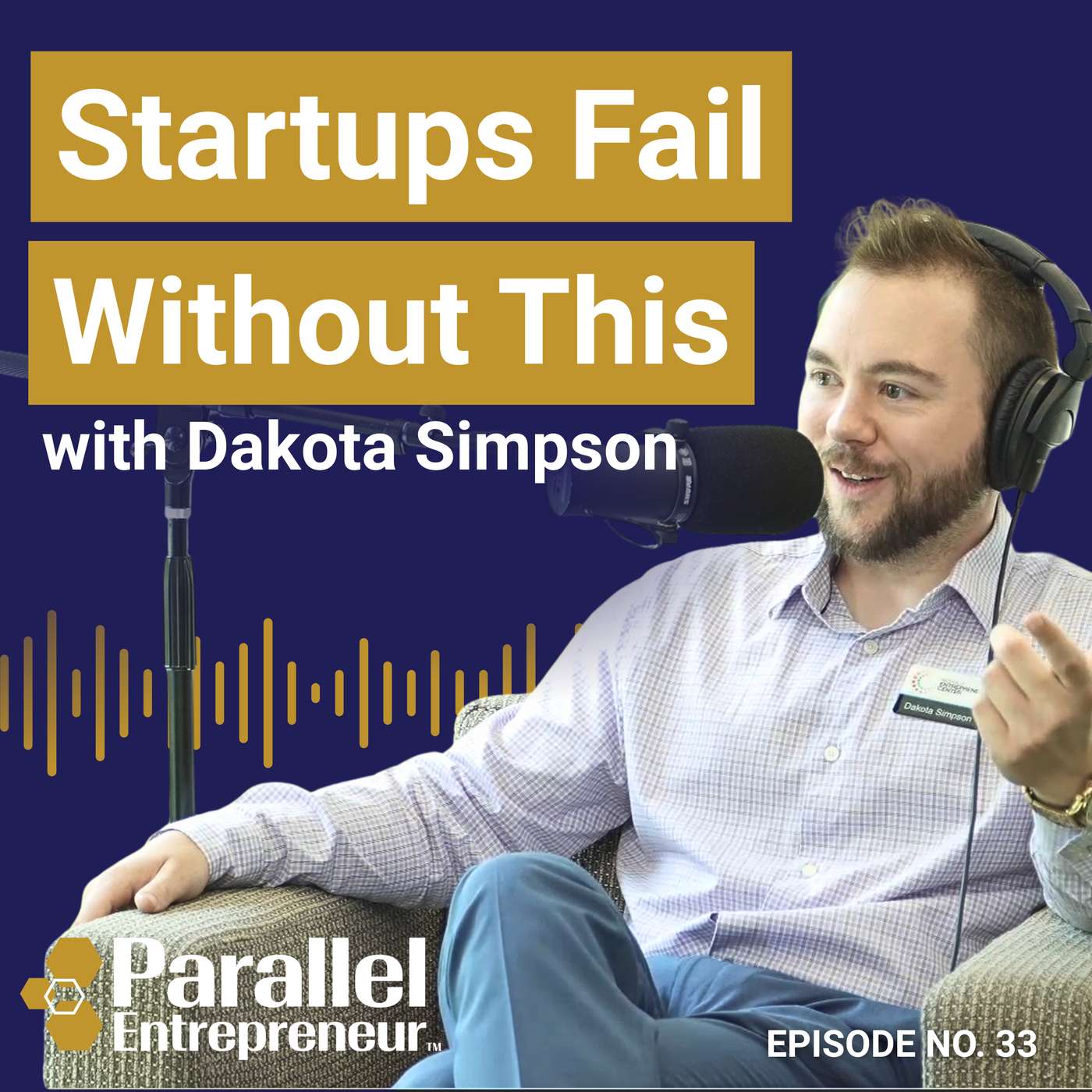
Episode 33 · Dakota Simpson

Why Founders Don’t Succeed Alone | Dakota Simpson

Parallel Entrepreneur with Mark Cleveland · Episode 33

0:00 / 21:59
Why Founders Don’t Succeed Alone | Dakota Simpson
0:00 / 21:59

Episode notes

In this episode of the Parallel Entrepreneur – Innovation Series, Mark Cleveland and Johnny Anderson sit down with Dakota Simpson, Chief Program Officer at the Nashville Entrepreneur Center.

Dakota is focused on a simple idea: founders don’t succeed in isolation. They succeed when the right systems, support, and structure are in place around them.

At the NEC, he leads the strategy and execution behind accelerator programs and founder development, helping entrepreneurs access the resources, networks, and guidance needed to grow.

But this conversation goes deeper.

It’s about what actually drives founder success beyond the idea.

They cover:
• Why ecosystems matter more than individual effort
• The role of structure in startup success
• What founders actually need at different stages
• Aligning programs, people, and outcomes
• Building more inclusive pathways to growth

Short, practical, and grounded in real experience.

Links 
- boringcompany.com
- technologycouncil.com
- nashvillechamber.com
- ec.co
- williamsonchamber.com

About the Guest
Dakota Simpson is Chief Program Officer at the Nashville Entrepreneur Center, where he leads startup accelerators and founder programming. With a background in government and nonprofit leadership, he focuses on building systems that improve access, strengthen execution, and help entrepreneurs grow with clarity and support.

Follow Dakota on LinkedIn

About the Hosts

Mark A. Cleveland
Managing Director at Kensington Park Capital, entrepreneur, M&A advisor, and host of the Parallel Entrepreneur Network
Follow Mark on LinkedIn

Johnny Anderson
Nashville tech leader, GNTC board member, Entrepreneur-in-Residence at the Entrepreneurship & Innovation Center, and host of The Impodsters™
Follow Johnnyonbrand on LinkedIn

Links & Resources

👉 Learn more about the Entrepreneurship & Innovation Center (EIC):
wcs.edu

👉 Join the Parallel Entrepreneur Network:
parallelentrepreneur.com

👉 Subscribe for more conversations with leaders building aligned systems across business, education, and community.

👍 If this episode resonated, leave a comment or share it with someone shaping the future of leadership.

Chapters
00:00:00 Speed to market and why it matters
00:00:50 Meet Dakota Simpson + role overview
00:01:54 What innovation actually means
00:02:40 Building a founder support system
00:03:42 The current surge in entrepreneurship
00:05:02 Growth in founder demand and programs
00:06:14 Shifts in founder demographics
00:07:46 Younger founders entering earlier
00:09:08 The rise of the parallel entrepreneur
00:10:32 Lower barriers and earlier risk-taking
00:11:05 Entrepreneurship by acquisition
00:11:37 AI’s impact on founders
00:12:30 What AI means for SaaS and business models
00:13:55 Speed of change and access to knowledge
00:15:00 What founders actually need to succeed
00:17:30 Building systems that support growth
00:19:30 Final thoughts on supporting entrepreneurs
00:21:00 Episode close

Chapters

  1. Speed to market and why it matters
  2. Meet Dakota Simpson + role overview
  3. What innovation actually means
  4. Building a founder support system
  5. The current surge in entrepreneurship
  6. Growth in founder demand and programs
  7. Shifts in founder demographics
  8. Younger founders entering earlier
  9. The rise of the parallel entrepreneur
  10. Lower barriers and earlier risk-taking
  11. Entrepreneurship by acquisition
  12. AI’s impact on founders
  13. What AI means for SaaS and business models
  14. Speed of change and access to knowledge
  15. What founders actually need to succeed
  16. Building systems that support growth
  17. Final thoughts on supporting entrepreneurs

Full transcript

speed to market is critical we we know that every single day whether you're bootstrapping or whether um you're that AI company trying to beat someone to the market to be able to establish you know brand dominance you gotta get there fast right so we're all racing very quickly welcome to the Parallel Entrepreneur this is a special series on innovation supported by Relationalary Marketing and the Chase Studios recorded at the Greater Nashville Technology Council Innovation Summit I'm joined today by guest host Johnny Anderson he's the entrepreneur in residence at the Nashville Entrepreneur Center sit back and join us for this special edition of

Having Authentic Conversations with People That Care building a strong entrepreneurial city doesn't happen by accident it requires systems that actually work Dakota Simpson is the Chief Program Officer at Nashville's Entrepreneur Center where he leads five accelerators supporting founders at every stage his work sits at the intersection of entrepreneurship economic development and community impact Dakota is on a mission to nourish entrepreneurial spirit in Nashville what makes Dakota's perspective unique is how he thinks beyond individual companies he spent his career working in government

nonprofit and cross sector environments aligning people programs and incentives so that people can flourish in our conversation we explore why entrepreneurial ecosystems must be intentionally designed not just enthusiastically supported and how building the right systems makes founder impact more sustainable let's just dive right into this conversation what does innovation mean and then specifically what does it mean to national I think everyone's answer to what does innovation mean um varies because it's a very ambiguous term for for me it's it doesn't necessarily imply creating something new I think it means doing something in a new way um I'm I'm a big fan of economic development

and let's call it continuums of care so I don't think we should ever innovate in a vacuum so for me Nashville innovation what that means is are we connecting the dots across multiple disparate organizations in a meaningful way that drives impactful change in our city so that's a lot of hoopla so let's let's run with a tangible example right yeah I'm not sure that's hoopla what's a meaningful way to define that yeah yeah yeah so I think for instance like let's let's run through a founder's uh continuum so let's say um we've got a founder that's interested in the healthcare industry so they start a healthcare company that reduces friction within the healthcare sector

we could say our jobs done they've started that company and they've got a business plan it's vetted seems viable we've connected with them with some advisors great but then what right they may need a chief technology officer or they may need to uh contract out with software developers then we may introduce them to the National Technology Council to really kind of run with that continuum and continue fostering that um startup and then from there it shouldn't stop either we should hand them off to the local chamber of commerce and make sure they're getting connected into the broader eco ecosystem and making sure uh they're landing clients and assisting HCA

and then who knows it's almost like a feedback loop it's innovating reducing friction in a meaningful way that in the aggregate is more impactful than the invention or service that's been produced it's a tangible ripple effect across our entire community so all these um reflections of success and alignment how how would you describe something that's frustrating what's frustrating now that's really interesting Mark I don't know if I've been asked that lately what is frustrating I mean if you want me to be candid it's it's frustrating trying to keep up with the uh the energy we've seen but it's it's frustrating in a good way the the entrepreneurial energy we've seen post pandemic

the explosion of entrepreneurial rates I mean it's through the roof and and really what's incredible about the data we were just looking at this last week is um it's not went down so you know what you would expect pre pandemic or what I would have hypothesized is oh a lot of people go remote they may have excess time on their hands they may um become you know unhappy with their employers and they may launch their initiatives okay that spikes up everything goes back to normal and you know then they return back to work but guess what happened it didn't go back to normal right we still have a lot of remote work we still have a lot of people that are innovating

a lot of people still frustrated with their employers and we know adversity births entrepreneurship a lot of the time so it's been fascinating to watch that those entrepreneurial rates maintain and at the National Entrepreneur Center we graduated 118 founders last year the year before that it was about 90 This year we're on track to graduate 200+ founders like we're getting ready to double the impact we have as an organization and that's a credit to Sam Davidson our leadership our board and all these people that are working hard behind the scenes but candidly it's also a credit to you know your everyday person that's deciding hey I wanna take my future and put that in my own hands

and I'm gonna be brave enough to go out there and launch a business so what's frustrating me at the moment is there's all of these amazing entrepreneurs and there's so many incredible ways to serve them but we're trying to balance like you know breadth but also depth of services because we wanna serve them all but we also wanna serve them all effectively and that's something new for us as we've seen this energy and explosion in the city um I have a theory that uh there's entrepreneurship there are people that we recognize as serial entrepreneurs one after another and and I've been working on a thesis and a research project and and exploring the identity of a parallel

entrepreneurship experience more than one company at the same time and in that exploration I've noticed some trends I'm curious if you're seeing any trends here in Nashville related to the average age of the entrepreneur what's the demographic looking like and how has that changed uh in your experience and I'll share what my theory is but I wanna hear what your experience is this the do old guys have a chance question I like that question do you and I have a chance yeah no I mean I I would share well first off Johnny of course you've got a chance um yeah no I I would share that um typically we we see we're serving um founders of all ages um and from all demographics

but I mean it's it's true if if you look at the trends and something we're seeing especially as we talk about perspective collaborations with um Metro National Public Schools or Belmont University Vanderbilt is um the entrepreneurial um participation by the younger generation Gen Z specifically is through the roof uh I believe it like last glance one out of every two um Gen Zers state that you know they're interested in starting a company and almost that many actually do in some form now it's it's not companies like you know um i i say we might think that implies i'm i'm y'all's age but just to be honest i've got an old soul so maybe i can kind of relate

but you know we're not talking about starting healthcare companies we're talking about you know we might be operating a TikTok or you know we might be monetizing video games or you know it may actually be some more hands on stuff we see that and that's providing those individuals with revenue and money and and that is a business well and I'm seeing it as micro SAS services sure I'm seeing it as uh AI problem solving for one specific thing they really understand and it they just set it and forget it and it runs off yeah it's a subscription I'm seeing people excited about simple things like a simple like running a food truck sure I mean but I my but my theory

I think it's being reinforced by this observation I think the younger you are the more likely you are to emerge into entrepreneurship as a parallel entrepreneur you've got one two three four things going this whole side hustle culture the the independent contractor perspective that that a lot of people bring and maybe I'm not saying that starting a healthcare company that's gonna become something the next big anchor in town is is not not possible I'm just observing this uh more more explosive more creative more deeply niche entrepreneur at a younger age with technical skills um really putting a some

some dynamite in in uh in the entrepreneurial path I think yeah I mean and hey it it makes a lot of sense like if you really dive a little bit deeper right is they they grew up in that environment that's that's a skill that you know we had to train ourselves on but that was acquired by extension of you know their their environment right so that's that's something that's kind of ingrained in that population I mean if you think about it I I remember when um growing up I was I was raised by three incredible strong women and one of them was my great aunt I remember she had a Blackberry iPhones didn't even exist right so it's a whole different ballpark

whenever you've actually grown up with those innovations around you and you've been Learned how to use them play with them test them from a young age but I'll I'll also share probably equally important if not more important is um the barrier to entry is way lower when you're younger you know I started a company whenever I was 16 um doing djing and event planning and running out venues well guess what it's a lot easier to do that when you're not paying rent every month right it's a lot easier to do that when you have excess time on your hands because yeah of course you go to school and of course you've got homework but you don't have all of the responsibilities of life

that come down the road so I think you see that our job is to make sure we're continuing to enforce that and make sure the younger generation is aware that hey there's a lot of adults that dream and work hard every single day to work for themselves and to have that freedom and that flexibility and you're at a unique point in time where you can start that before all of these problems not problems well sometimes the problems it depends on the day yeah I mean Nashville Athens of the south there's 120,000 college students in this town that I suppose it should be natural that there would be any a real bloom in entrepreneurship at that at that level

entering the culture here in Nashville and then choosing to stay sure yeah and you know what's really interesting too is just the entrepreneurship by acquisition we can I don't want to interrupt Johnson I want you to finish your thought but like let's let's go down that rabbit trail because we're seeing that trend as well quite a lot well I think this is first conversation I've been in in weeks that AI didn't come up in the first like you know 3 questions but um it's a good segue specific to entrepreneurs what do you think AI's impact and this is gonna be a big question but what do you think the impact's gonna be or what are you seeing some of the impacts right now

yeah I I really go back and forth on AI just to be candid with you Johnny because alright so let's start with the obvious AI has caused an immense explosion and entrepreneurship across the nation um but to your point Mark a lot of that entrepreneurship is you know we we call it AI rappers right these individuals are able to kind of vibe code if you will and create a B to B or B to C subscription that really a lot of consumers could probably get if they interacted with chat GPT in a meaningful way it's just easier for them because the friction's been reduced right and it's already been built so I go back and forth because we've seen an explosion of businesses

and an explosion of energy around AI which is fantastic but also it makes me question how how sustainable is that as ai continues to mature um and develop like i've heard theories i'd i'd love to hear y'all's thoughts on b to b sass is you know soon to be extinct cause why do you even need a software if we eventually get to an AI platform that is able to do all of that for you so think about Tableau for instance data visualization platform do you really need that platform to input all of your data and manipulate it into visualizations if you have a chat GPT bot or an AI bot that you're able to interact with and then it spits the visualization out to you right

you've actually circumvented the need for the enterprise platform altogether at that point so yeah it's a mixed bag for me Johnny and it's something we're still um observing at a high level what I share with my friends whenever they ask me this question is I think in the long term AI is just like your iPhone it's not gonna replace you but it's a tool that you better become familiar with and you better learn to use because it's gonna be with us for quite some time yeah people deserve to have better tools sure and everything that we talk about from a technology perspective is just a tool I think wouldn't it be cool if we could just talk to the computer

and spit out an app which I just spent 9 years building a company that built apps you know wouldn't it be cool if you could vibe code your way into rapid innovation and I I think it's the speed of innovation that is um breathtaking right now yeah you there the barriers you called you said earlier the barriers to entry are lower knowledge is no longer a barrier to entry sure for almost everything um but I think knowing what kind of problems what kind of questions to ask and what kind of problems to address are probably where the solution meets financial success and and really serves a lot more people faster I'm I'm but speak about speed

talk about how fast this is happening to to in your observations to Nashville with Nashville how fast is things going oh it's yeah um very fast I mean just to speak once again about kind of the volume um of individuals we're serving we're we're seeing those numbers go high I mean double right um and I know we're not the only organization experiencing that with the same staff yeah yeah with the with the same staff um but you know we we roll up our sleeves and we work hard because we understand that the impact while fulfilling on the individual level getting to work with individual startups is meaningful the impact is way larger than that I mean when we work with one startup

we know small businesses drive um the economy right so we're talking about ripple effects throughout the entire region so we're small and mighty but we're also determined um to make sure we we make an impact but yeah the the speed is incredible um Mark in terms of the amount of founders that are innovating in terms of um the innovation how bold their ideas are and how how much it just makes sense whenever you encounter these ideas and the amount of friction we're seeing reduced in our lives so but that's good right need the market is critical we we know that every single day whether you're bootstrapping or whether um you're that AI company trying to beat someone to the market

to be able to establish you know brand dominance you gotta get there fast right so we're all racing very quickly and yeah I think I've run out of breath just talking about it I mean it's pretty it's exhausting but it's in a good way right and I think that that's the challenge is like how do you keep up with the speed as an entrepreneurial support organization as a founder trying to inventory all of these resources as a consumer you know I um I love leveraging AI but it's like I find one AI chatbot and it feels like there's another one that's superior tomorrow than the next day than the next day and kind of wears you down a little bit haha you know

on AI I find I just tell myself just dig into one become as comfortable an expert with one I've heard a lot of people move from oh this one shiny object and then this one it does a little something better and I got some friends who are pretty sharp at this and they they set up playgrounds and sandboxes for the different AI tools to interact with one another and some CEOs that I know are spending an extraordinary amount of time in AI like maybe more time in AI than and and in product planning and in sort of just really defining the direction of the company than I've than I've experienced in the past because they're tech oriented and they're smart people

um but they're digging in really deeply uh and then I hear an occasional story about somebody who lost their job recently and has been looking around and has spent the last 6 months pouring into AI and their level of excitement they don't feel unemployed they feel like they're about ready to take on the world so it's like an empowering thing it's a deep dive thing and it's also like it's an experience it's a living experience it's just one of the most exciting things that's happening in our culture right now I think well in some of our conversations we've we've we talk AI we go straight to the technology and the technology companies but at the Entrepreneur Center

we've watched a pasta sauce lady yeah that has leveraged AI to get her faster to market to get remove some of those friction points that an entrepreneur might spend four weeks and 10 15 $20,000 on getting their statement of work together or their contract components or their terms and conditions and in a lot of ways we we often forget that there's a lady out there making pasta sauce and the faster she can get that pasta on the shelves the better let's not forget those the world still needs ball bearings sure and I I'm I get as excited about that component as I do the technology itself and Mark I think it's to your point it's a tool for people

let's not forget that it's not the thing unto itself it's it's a tool for people and it it's a tool that opens up a lot of opportunities I mean to to your point about um Gina right there there's another um entrepreneur that that we've served a Jason Reeves who came in with a photography company but he left with an AI company yeah so I mean he he from he leveraged AI in unique ways that really helped his service based business and before you know it he's sharing that thought leadership with individuals that were members of his cohort and he realizes hey there's an opportunity here maybe I should be instructing people on how to use AI to really

assist their small and medium sized businesses now that's predominantly his main gig so opportunity there you just discovered you just like lifted up the covers on a topic about listening um he in this example saw an opportunity he's listening participating in a market and listening what are some of the things that you'd like to see people listen to more hmm

I think broadly I would say I would like to see people not only listen to but validate others ideas a little bit more and then I'll I'll get a little bit more of a specific answer for you Mark but what I'm saying is we see time and time again regardless of AI this is pre AI and this is now even with AI the No. 1 reason startups fail are product market fit time and time again they experience a problem of their own and they think oh I'm gonna solve this issue and everyone's got this issue so now we can move forward often times that's not the case and then they struggle to find a market yeah so you know just listening to others more broadly like I think Jason did a fantastic job of that

it wasn't enough to say hey I'm struggling with this in my service based industry it's hey let me actually talk to other founders and better understand if they're struggling with the same concepts or there's other areas I can encounter right and he kind of took that and really ran with it utilizing AI so I mean I don't know selfishly I'm a I'm a community and economic development guy like if you look at my resume that's what I've done my whole life I wish people would look at more um more micro economic um issue so on a city wide level and lean into that with innovation um I'm excited about the recent boring announcement like I think that that's an innovative way to get US

transportation transporting individuals but that's not enough right and I think affordable housing like all of these like buzz topics but they're they're main topics for a reason because people are experiencing them every day and like I I watch and I encounter it in our community I'd love to see people listen to those problems more and actually step up and demonstrate ownership and truly innovate and drive some more meaningful outcome hey thanks for listening to another episode of The Parallel Entrepreneur and thank you to our sponsors partners and the special team behind the scenes that make it all possible be sure to like follow or subscribe to our podcast and get the latest updates

and to learn more about this growing community of entrepreneurs our mastermind and companion program for your parallel entrepreneur journey visit Parallel entrepreneur.com and of course thank you to all the visionary guests who trust us to share their stories

Building more than one venture?

The Parallel Entrepreneur Network is a private, vetted community of founders running multiple companies at once. New to the idea? Start with what a parallel entrepreneur is.

Apply to the Network

← All podcast episodes